

Understanding Your Energy Balance: A Guide to Managing Weight
If you are reading this leaflet, it means you’ve already taken a positive and vital step toward improving your health and wellbeing. I want to congratulate you for taking the initiative to learn more about your body, your metabolism, and how small daily choices can have a lasting impact.
This leaflet has been designed to support you in understanding how your body uses energy and how you can work with it, rather than against it, to achieve your goals. Whether you aim to lose weight or maintain a healthy balance, the information here will guide you through practical, evidence-based strategies that can make a real difference.
Remember, meaningful change starts with awareness, and by reading this, you are already on your way to building healthier habits that last.
1. Understanding Your Energy: BMR and TEE
Okay, let’s first try to understand how your body uses energy, and two important concepts called BMR (Basal Metabolic Rate) and TEE (Total Energy Expenditure). These two numbers help us understand how much energy your body needs each day and how that affects your weight.
Your body’s energy needs (calories) are determined by how much energy you use every day. To lose weight, you simply need to take in slightly fewer calories than your body uses over time.
Your Personal Energy Results
(These would have been calculated for you, please make a note of them here)
Your Basal Metabolic Rate (BMR): …………. kcal/day
Your Total Energy Expenditure (TEE): …………. kcal/day
These values are calculated using your age, height, weight, and activity level. This is also referred to as your natural ‘Set point’
So, What Do These Numbers Mean?
Your BMR (Basal Metabolic Rate) is the total number of calories your body needs each day to carry out its basic metabolic functions — the essential processes that keep you alive, such as breathing, circulation, digestion, maintaining body temperature, and cellular repair.
Your TEE (Total Energy Expenditure) represents the total amount of energy your body uses in a day, combining your BMR with additional energy spent on physical activity (movement, work, and exercise) and digesting food.
Together, these two numbers provide a clear picture of the energy your body truly needs each day.
2. Balancing Energy for Weight Maintenance
Now that you understand your body’s energy needs, let’s talk about how to keep your weight steady — or how to gently shift it if your goal is to lose weight.
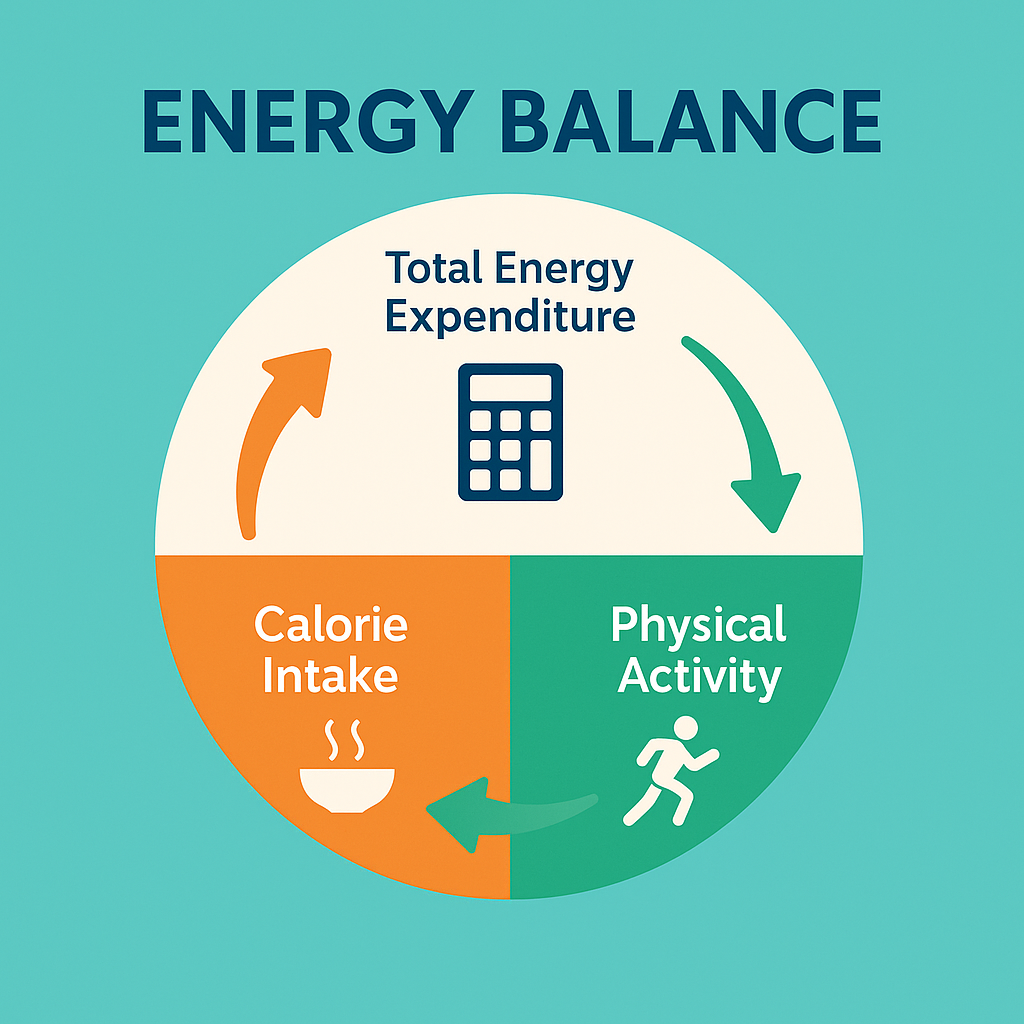
To maintain your current weight, the calories you eat (calories in) must match the calories your body uses (calories out). This is called energy balance — or more simply, ‘calories in equals calories out.’
Calories in equals TEE
If you would like to lose weight, your calorie intake needs to be slightly lower than your TEE. This creates a small but steady energy deficit, leading to gradual and sustainable weight loss.
If you would like to lose weight, your daily calorie intake must be lower than your TEE to create a negative energy balance (energy deficit). The following section explains how to achieve this safely through calorie restriction.
3. Creating a Calorie Deficit for Weight Loss
If your goal is to lose weight, the key is to create a small and steady energy deficit — in other words, eating slightly fewer calories than your body burns each day. Let’s look at two main approaches:
1. Moderate Hypocaloric Diets (for standard weight loss)
A moderate-calorie diet promotes an energy deficit of 500 to 1,000 kcal per day.
This usually results in a weight loss of approximately 400 g to 1 kg per week.
Dietary guidelines often recommend energy intake levels of:
○ 1,200–1,500 kcal/day for women.
○ 1,500–1,800 kcal/day for men.
1b. Alternatively, a simple starting diet plan includes reducing intake by about 600 kcal below your estimated daily requirement, leading to a weight loss of around 0.5 kg per week. Further reduction depends on how much you can safely manage based on your lifestyle and other medical conditions.
2. Very Low Energy Diets (VLEDs) (for rapid weight loss)
For rapid weight loss, calorie intake may be severely restricted, typically around 3,280 kJ (800 kcal) daily.
VLEDs are mainly used for individuals with obesity or severe obesity, especially when associated with conditions such as type 2 diabetes or as preparation for bariatric surgery.
These diets should only be followed under medical supervision to ensure appropriate micronutrient intake and monitoring.
6. Adjusting After Weight Loss: Staying on Track
Maintaining weight loss is often more complicated than losing it initially. This is because your body undergoes powerful physiological changes that favour weight regain.
When you lose weight, your body responds by defending its previous “set point”:
Reduced Energy Needs: Weight loss causes your Total Energy Expenditure (TEE) to decrease by more than would be expected simply for the reduction in body mass. For example, a 10% weight loss can lead to a 15% greater reduction in TEE below the expected level.
Increased Hunger: Hormonal changes occur (e.g., satiety hormones decrease and hunger hormones like ghrelin increase), making you feel hungrier.
To successfully maintain weight loss and prevent rebound weight gain, you must continue efforts indefinitely.
4. Small Extras That Add Up Over Time
One thing that surprises many people is how small changes in calorie intake can have a significant impact over time. Even a 1–2% increase in daily calories can lead to weight gain over the years.
Here are some examples of everyday extras that can quietly add up:
| Small Daily Extras | Approximate Extra Calories |
| One plain biscuit or small cookie | ~40 kcal |
| One teaspoon of sugar in tea/coffee | ~20 kcal |
| Half a slice of buttered toast | ~50 kcal |
| Small handful of crisps | ~60 kcal |
| A few extra bites of dinner | ~40 kcal |
| One small chocolate square | ~50 kcal |
These small extras can easily go unnoticed — but over time, they can contribute to several kilograms of weight gain if repeated daily.
Strategies for Maintenance
1. Sustained Energy Control: As energy requirements fall after weight loss, maintain awareness of calories and reduce them accordingly or increase physical activity to match.
2. Long-Term Therapy: Combine dietary, physical activity, and behavioral therapies for lasting success.
3. Proactive Management: Ongoing follow-up and monitoring help sustain motivation and prevent relapse.
5. The Power of Modest Weight Loss (5–10%)
You don’t have to lose a large amount of weight to see real benefits. Even a modest 5–10% reduction in your body weight can lead to major improvements in your overall health, energy, and well-being.
Here’s what even a slight, steady weight loss can do for you:
The primary focus of weight management is improving health and well-being, rather than just achieving a target weight on the scale. A realistic first goal is a modest weight loss of 5–10% of your starting body weight — achievable within six months for most people.
Achieving just 5% weight loss is associated with essential health improvements:
Metabolic Benefits: Reduced risk of type 2 diabetes and better blood sugar control.
Heart Health: Lower blood pressure and improved cholesterol levels.
Body Function: Improved liver and muscle insulin sensitivity.
Comorbidity Reduction: Milder symptoms of conditions such as sleep apnoea.
Quality of Life: Improved energy, mobility, and mood.
7. Tracking Your Calorie Intake
Finally, to help you stay aware and in control, here are a few simple ways to track your calorie intake. You don’t have to use all of them — pick the ones that work best for you.
Tracking your calorie intake helps you understand your eating habits and make small, consistent changes. You can choose one or a mix of the following methods, depending on what suits you best.
1. Apps and Digital Tools
Apps make calorie tracking easy by automatically calculating your daily totals and providing feedback. Many smartwatches, such as Apple Watch, Fitbit, or Garmin, also integrate with these apps to show your calories in vs. calories out.
Popular options include:
• MyFitnessPal – extensive food database with barcode scanning.
• Lose It! – quick meal logging and goal setting.
• Lifesum – combines calorie tracking with healthy eating advice.
• Cronometer – for detailed nutrient analysis.
• NHS Better Health: Food Scanner – scans supermarket items and interprets food labels.
Tip: Log meals immediately after eating to maintain accuracy.
2. Reading Food Labels
Learning to read food labels helps you estimate calories accurately and make healthier choices.
• Check the serving size first (many packages list calories per half portion).
• Look at the ‘Energy (kcal)’ value and compare per 100 g between foods.
• Watch for hidden calories from oils, sauces, or dressings.
• Choose lower-calorie, nutrient-dense foods such as fruits, vegetables, and lean proteins.
3. Visual Estimation
If you prefer not to count calories, you can estimate portions using your hand as a guide:
• Palm = protein portion (e.g., meat, fish)
• Fist = carbohydrate portion (e.g., rice, pasta)
• Thumb = fat portion (e.g., butter, oil)
• Two cupped hands = vegetables or salad
This method builds portion awareness without strict counting.
4. Photo Tracking
Taking a photo of each meal before eating helps improve awareness of portion sizes and frequency of consumption. Apps like Bitesnap, Ate, or YouAte can even automatically estimate calories.
You can also share these photos with your clinician to review your eating habits.
5. Manual Tracking
If you prefer not to use apps, you can keep a simple food diary for 3–7 days. Record what and when you eat, and compare your average daily intake with your Total Energy Expenditure (TEE).
6. Mixing Approaches
Start by tracking an app or food label for a couple of weeks to build calorie awareness. Then switch to portion and visual methods, returning to digital tracking occasionally to recalibrate your habits.
8. Summary and Next Steps
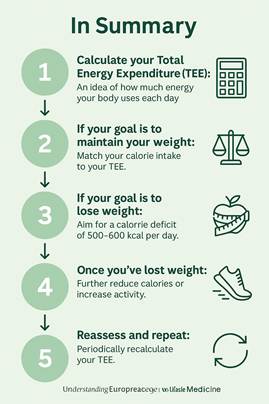
Managing your weight is about understanding your body’s energy balance and making minor, sustainable adjustments. Here’s a quick summary of how to put everything in this leaflet into practice:
Disclaimer
This information leaflet is based on scientific research regarding weight management. It is intended to inform discussions with your healthcare team, who will create a personalised plan tailored to your specific health needs and goals.
References
-
- Sharma A. An Etiological Approach to Obesity Management. Canadian Obesity Network /
-
- Lean MEJ et al. Lancet Diabetes Endocrinol. 2017; 5(3):233–244 (DiRECT Trial).
-
- Look AHEAD Research Group. Diabetes Care. 2014; 37(9):2422–2430.
-
- Wadden TA et al. N Engl J Med. 2011; 365:1563–1573.
-
- Sacks FM et al. N Engl J Med. 2009; 360:859–873.
Author:
Dr I. Mughal
General Practitioner | Functional & Lifestyle Medicine
GMC 6048767
GNC 3847