


Am I Eligible for Weight Loss Injections in the UK?
You may have heard about Mounjaro, perhaps a friend is using it, or you have seen the headlines about the NHS rollout. The real question you want answered is simple:
- Am I eligible for weight loss injections?
- If so, how do I get them?
The Two Things That Decide If You Are Eligible for Weight Loss Injections
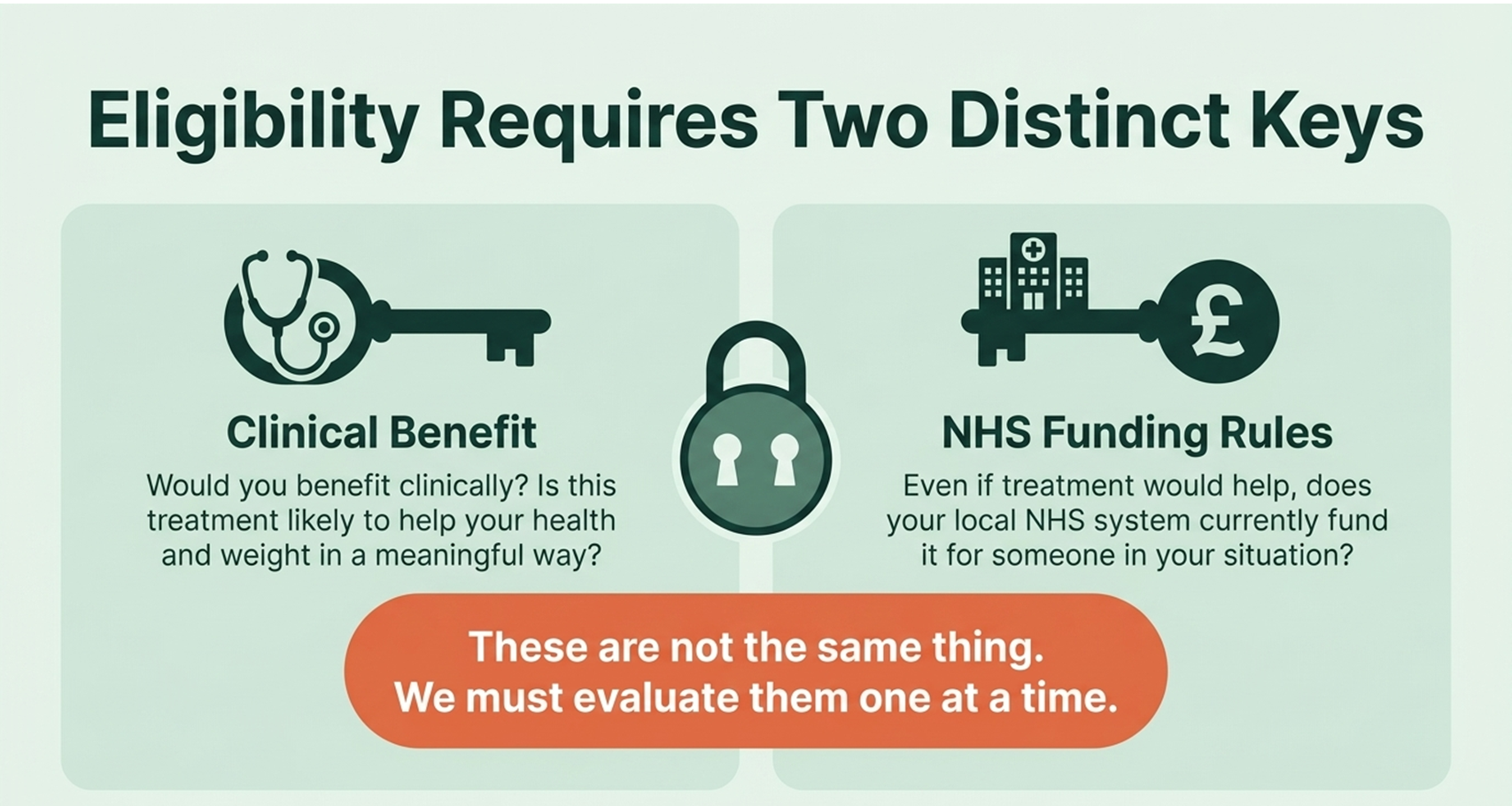
In the UK, eligibility for weight loss injections depends on two separate questions:
- Would you benefit clinically? Is this treatment likely to help your health and weight in a meaningful way?
- Do you meet the current NHS funding rules? Even if treatment would help, does your local NHS system currently fund it for someone in your situation?
These are not the same. This guide explains both, one at a time.
The Clinical Criteria: What NICE Says
NICE (the national body that reviews treatments) recommends tirzepatide (Mounjaro) for adults with:
- A BMI of 35 or more, and
- At least one weight related health condition, such as:
- type 2 diabetes
- high blood pressure
- abnormal cholesterol
- sleep apnoea
- heart disease
Lower BMI threshold for some ethnic groups:
- If you are from a South Asian, Chinese, other Asian, Middle Eastern, Black African or African Caribbean background, the BMI threshold drops to 32.5 (still with at least one weight related health condition).
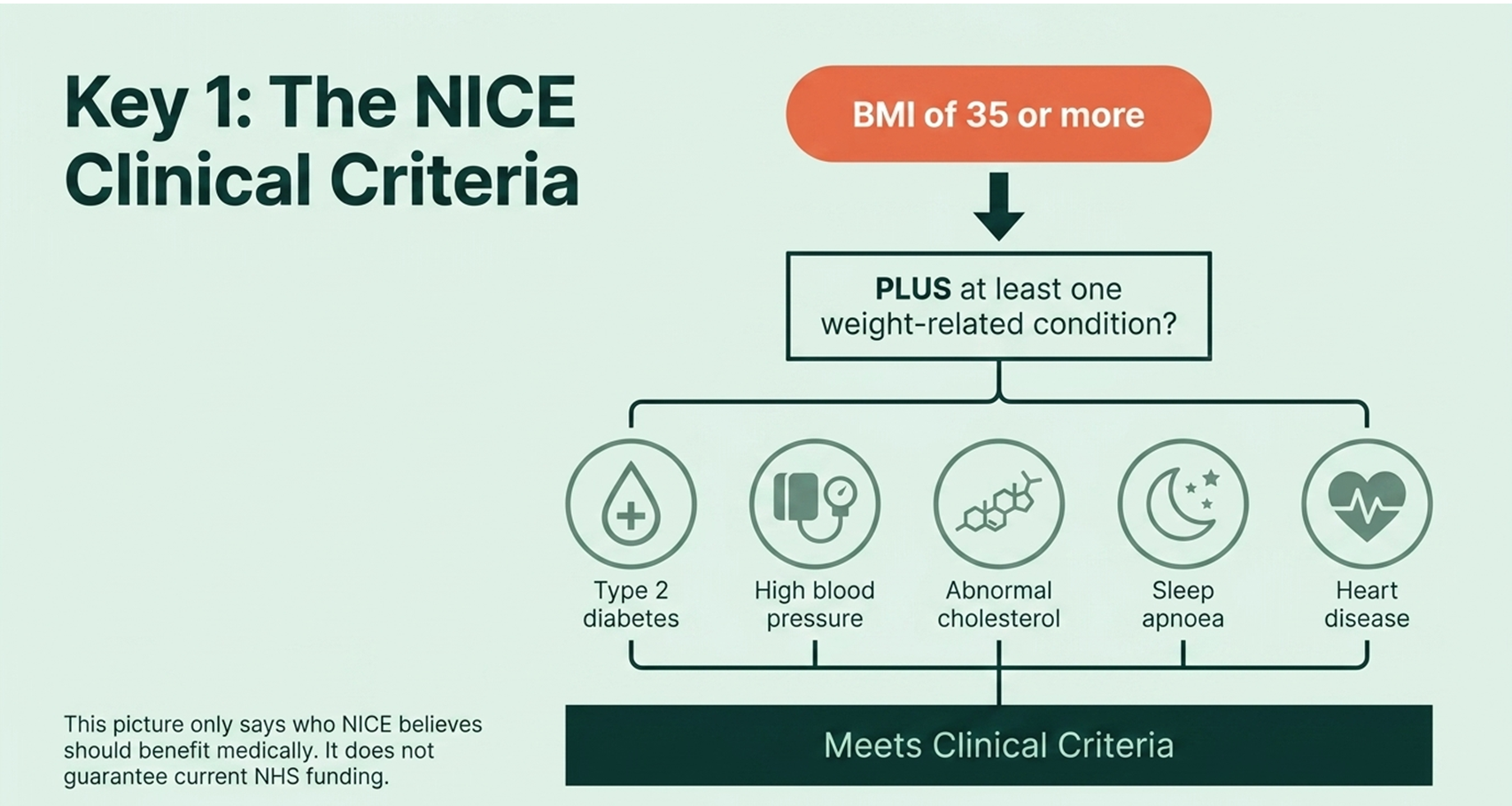
‘These are the clinical criteria, they say who should benefit medically.’
This is the clinical picture only. It says who NICE believes should benefit from treatment. It says nothing yet about whether the NHS can actually fund it for you today, that is a separate question, covered next.
The Funding Reality: NHS Access and Rollout
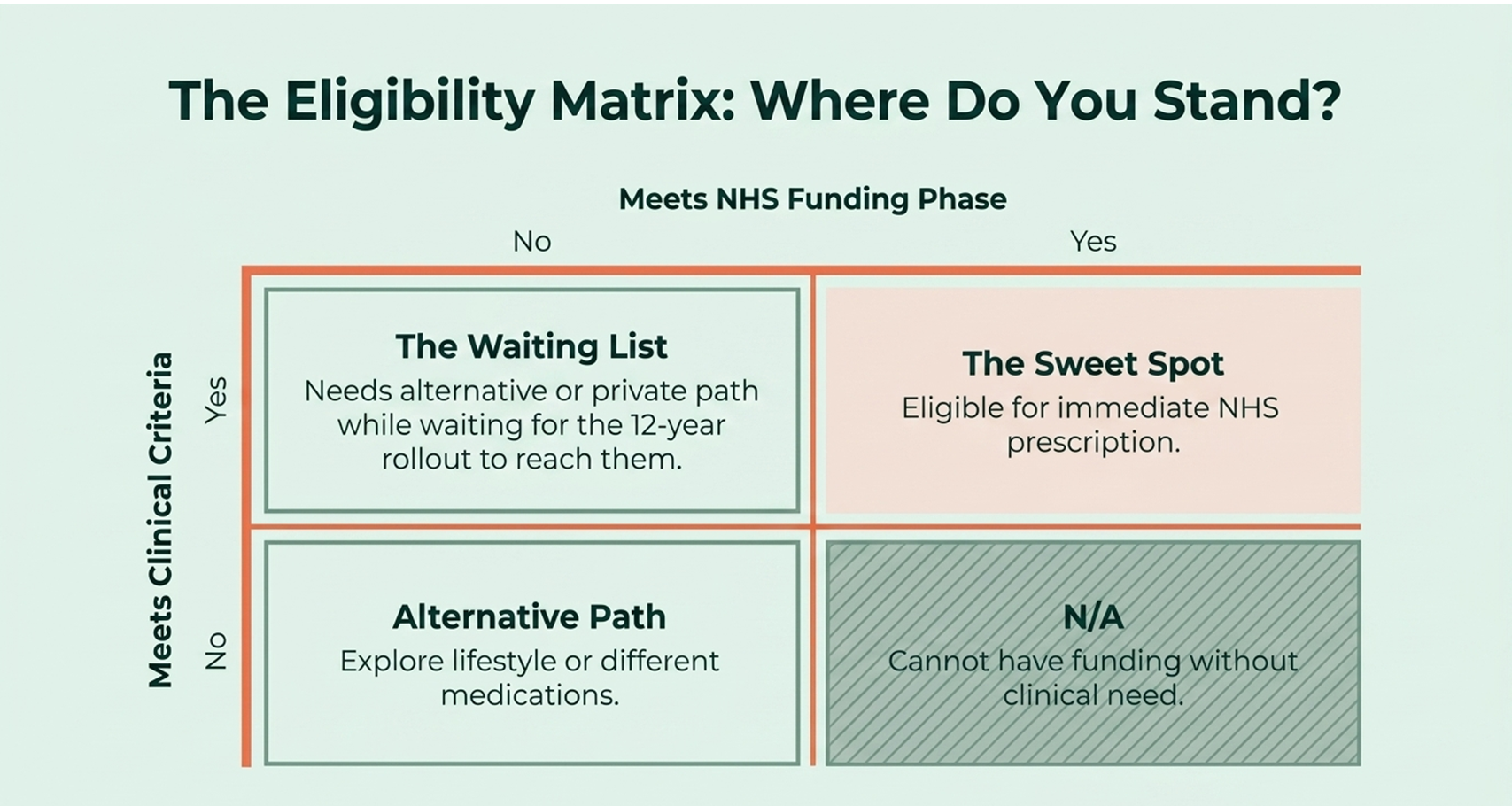
Meeting the clinical criteria above does not mean the NHS can prescribe for you right now. Full national rollout will take up to 12 years, so access depends on which stage has reached your area.
The current phase: people with a BMI of 40 or more, plus at least 4 out of 5 qualifying conditions:
- Type 2 diabetes
- High blood pressure
- Abnormal cholesterol
- Obstructive sleep apnoea
- Heart disease
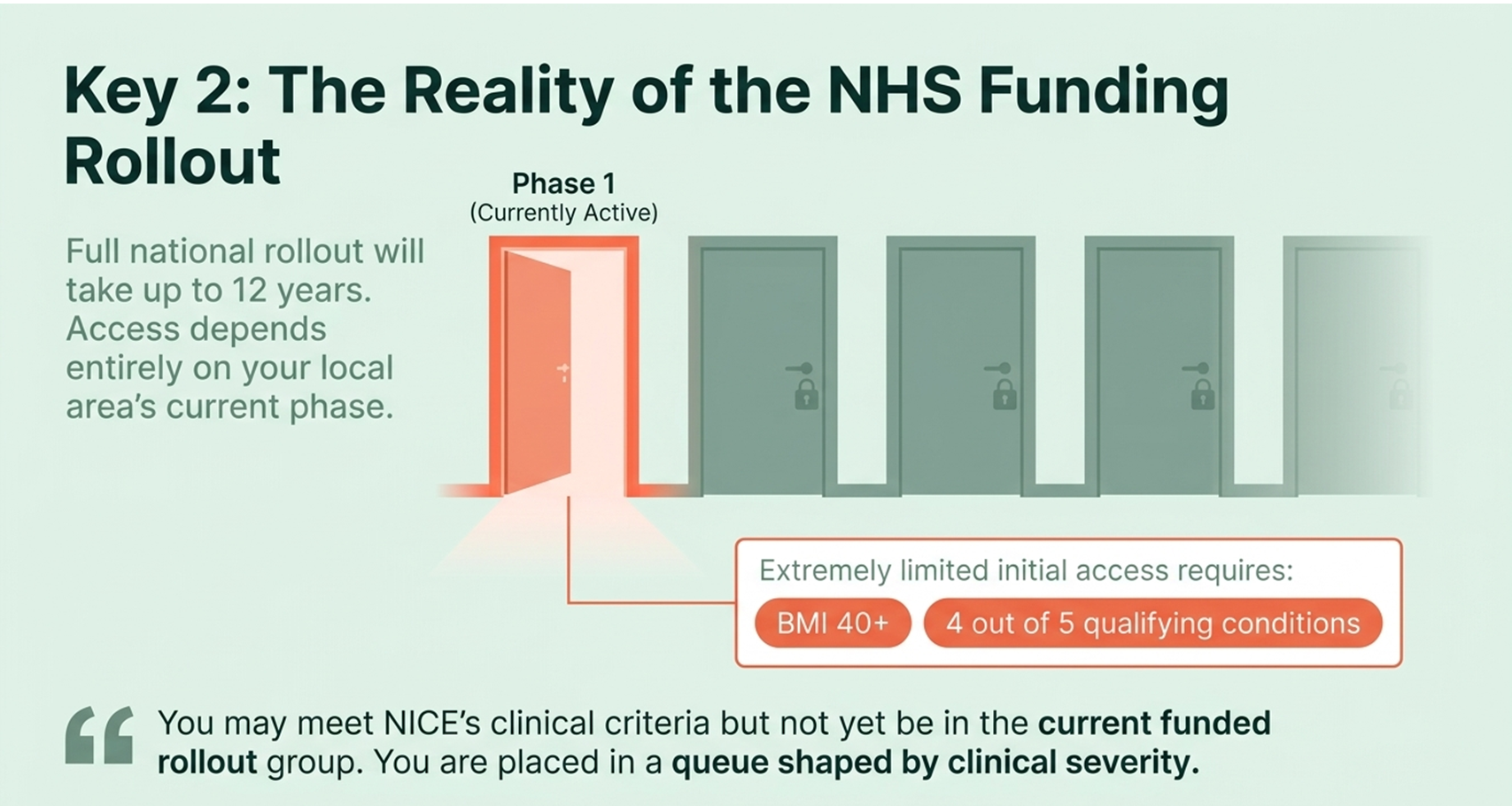
‘So you may meet NICE’s clinical criteria but not yet be in the current funded rollout group.’
Bottom line: Meeting the NICE clinical criteria does not guarantee a prescription. It usually means you are somewhere in a queue, shaped by how difficult your situation is, and what your local NHS has switched on.
Having Diabetes Does Not Automatically Make You Eligible for Weight Loss Injections
A common misunderstanding is:
“I have type 2 diabetes, so I should automatically qualify for weight loss injections.”
In reality, these medicines have two separate licensed uses, each with its own rules:
- For diabetes (blood sugar control): tirzepatide and similar medicines can be prescribed to help manage blood sugar in type 2 diabetes. This follows separate NICE guidance with its own criteria.
- For weight loss: this is a separate approval with the BMI and health condition thresholds described earlier.
So having type 2 diabetes does not fast track you into weight loss specific treatment.
‘It is one of the five qualifying conditions, not a golden ticket.’
Do Doses Keep Going Up Forever?
Another myth is that once someone is prescribed a weight loss injection, the dose should just keep increasing.
In practice, doses are adjusted to reach agreed targets and then usually stopped at that level:
- For diabetes: the dose is increased until your HbA1c (a blood test showing average blood sugar) reaches the target agreed with you, for example 58 mmol/mol. Once you are at target, no further increase is advised, even if your weight is still changing.
- For weight: at the start, you agree an initial weight target. Once you reach that target, the dose is usually kept the same, not pushed higher.
- If it is not working: NICE advises considering stopping tirzepatide if you have lost less than 5% of your starting weight after 6 months.
What happens when treatment eventually stops matters too. Many people notice some weight regain, and understanding this early helps you plan ahead. I cover that separately in an article on why weight often comes back after stopping the injections.
Not Eligible for Weight Loss Injections on the NHS? What Else Can You Do?
Falling outside the current NHS funding rules does not mean nothing can be done.
Options I often discuss with patients include:
- Orlistat (tablet): a licensed weight loss tablet available on the NHS under different criteria. Can work well for some people, especially with support around diet.
- Local lifestyle support: Exercise referral schemes from your GP. Local gym or swimming programmes. Structured group programmes (including Weight Watchers style services). These are not “just clubs”, many have good evidence behind them.
- Private treatment: the medicine licences allow prescribing from a BMI of 30, or 27 with a weight related condition. A responsible private clinic will still do a full clinical assessment first. “Eligible on paper” is not the same as “safe and suitable for you”.
The Key Points
- NHS eligibility depends on two separate things: the NICE clinical criteria, and a phased funding rollout that is still in progress. You can meet the clinical threshold and still be waiting for access, depending on where you live and how difficult your situation is.
- Weight loss and diabetes are two separate licensed uses of these medicines. Having diabetes does not automatically qualify you. Doses are usually increased only until agreed targets are reached, not indefinitely.
- If the NHS funding rules exclude you, there are real alternatives, including orlistat, local lifestyle services, and properly assessed private treatment.
What This Means For You
- If you are wondering whether you are eligible for weight loss injections, the first step should be an honest clinical assessment, not just a BMI calculator on a website.
- You deserve to know whether this treatment would genuinely benefit you, and separately, whether the current NHS rules will fund it for you.
- If you meet the full NICE criteria but your local rollout has not reached you yet, that is a funding position, not a judgement on your health or your need for support. And if you sit below the NHS thresholds, there may still be safe, licensed options worth discussing, either on the NHS or privately.
- At IM Clinic, I offer a clear, personalised assessment of whether these medicines are right for you, and an explanation of all your options, NHS, private, and non medication.
Author: Dr Imran Mughal, Private Specialist GP
Website: www.imclinic.co.uk
Book a consultation: Book a consultation
References
NICE. Tirzepatide for managing overweight and obesity. Technology appraisal guidance TA1026. 2024.
NICE. Semaglutide for managing overweight and obesity. Technology appraisal guidance TA875. 2023.
NICE. Type 2 diabetes in adults: management. NG28.
NHS England. Weight management injections. Patient information page.

We would love to hear your thoughts. A few things to keep in mind before you post: