


Causes of Palpitations: Telling Organic from Functional Causes
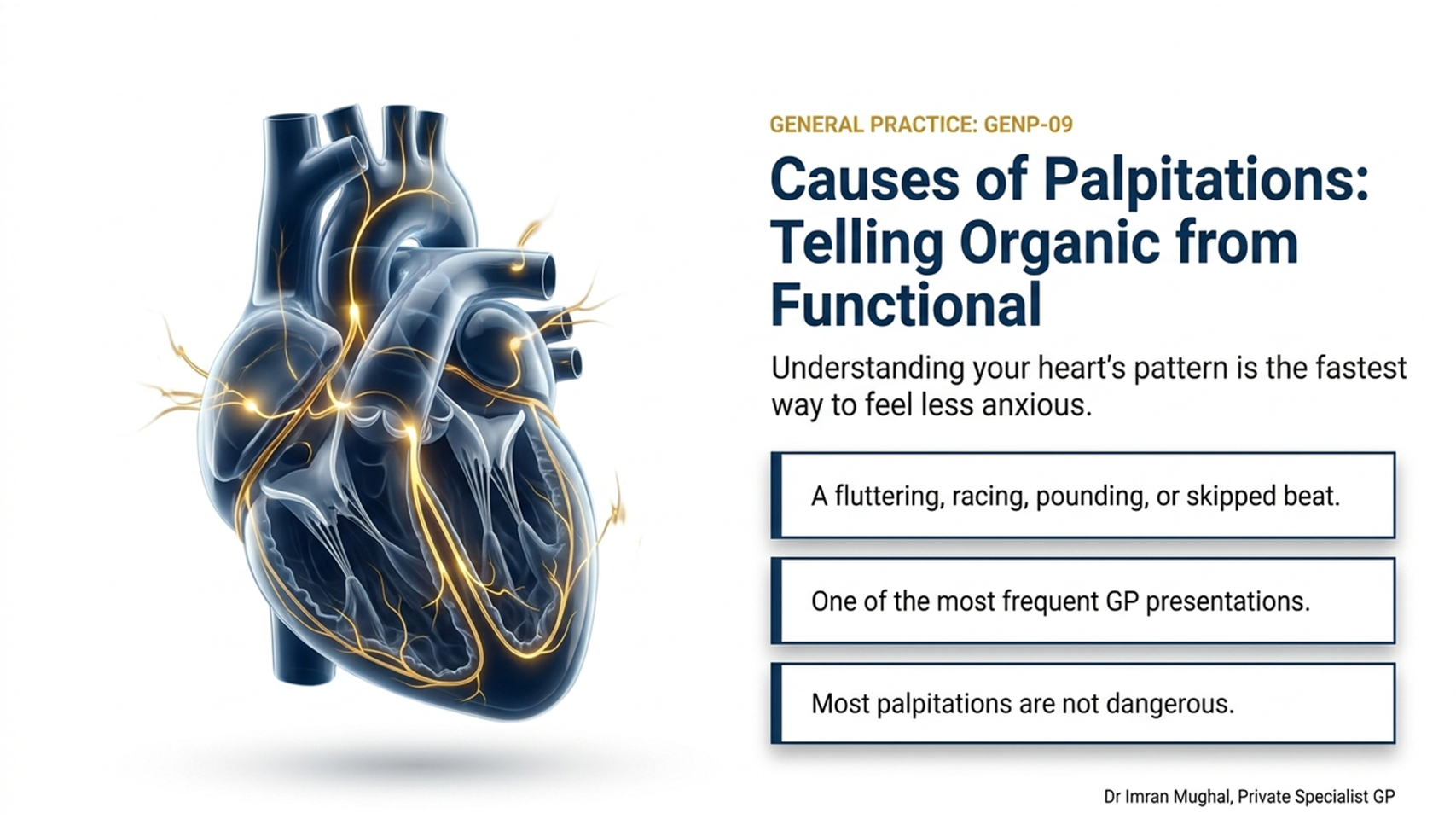
Heart palpitations are one of the most common reasons people come to see a GP, and understanding the causes of palpitations is often the fastest way to feel less anxious about them.
- My own experience: In my years of general practice, including time spent working as a GP within a university setting, this was one of the most frequent presentations I saw walk through the door.
- The feeling: A fluttering, racing, pounding, or skipped beat in your chest that suddenly makes you very aware of your own heart.
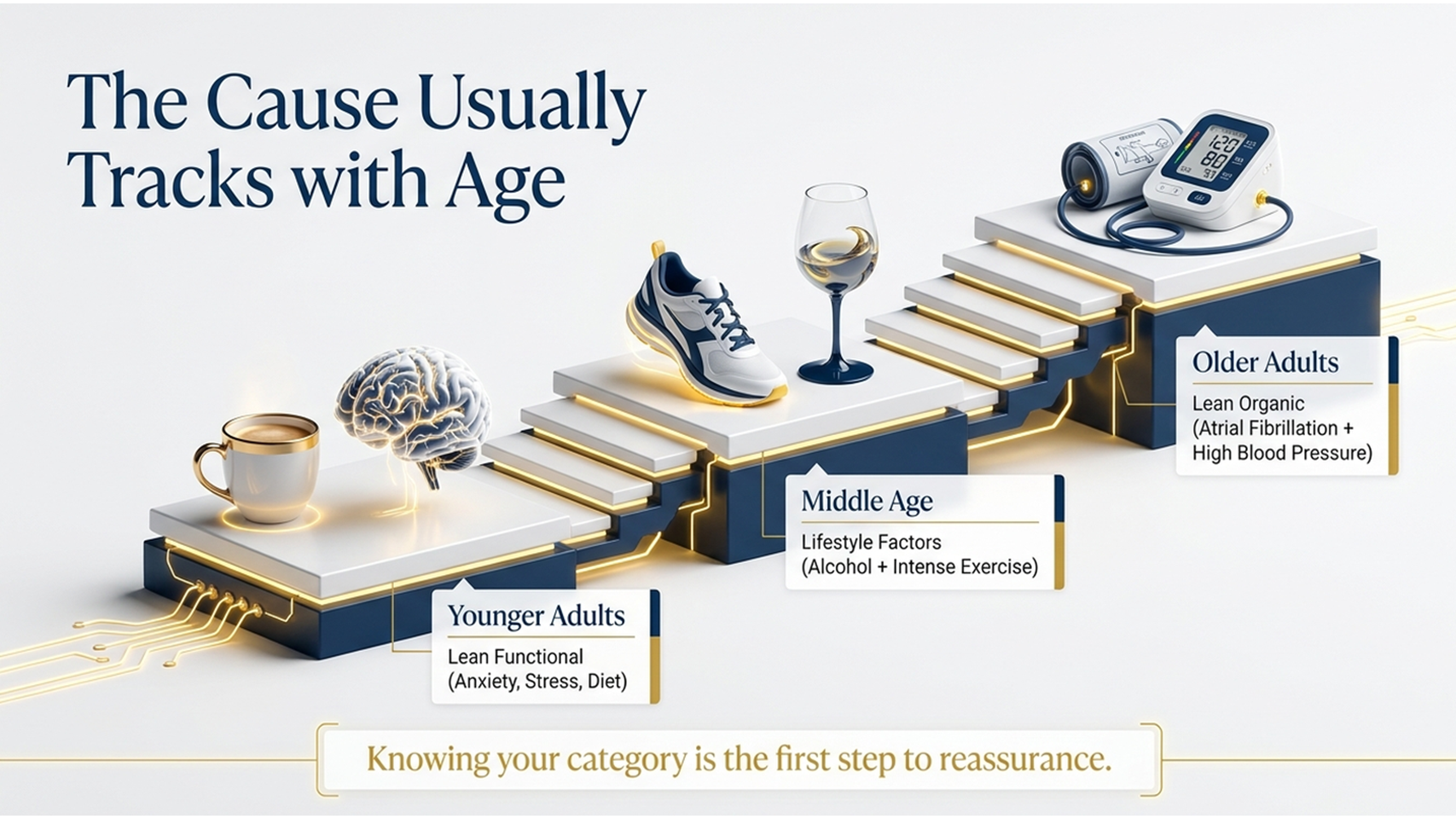
- The pattern: What is actually causing it usually tracks closely with age.
- In younger adults, anxiety and diet related triggers are the most likely cause.
- In middle age, functional and lifestyle causes take over. Alcohol is a common trigger, particularly layered on top of years of intense endurance training.
- In older adults, organic causes become more likely, particularly atrial fibrillation alongside high blood pressure.
- The reassurance: Most heart palpitations are not dangerous. Understanding which category yours fall into is the first step to worrying less about them.
What Do Heart Palpitations Feel Like?
Two things describe how your heart is beating.
- Rate is how fast your heart is beating, counted in beats per minute.
- Rhythm is whether those beats are evenly spaced or not, in other words, whether the pattern is regular or irregular.
Both of these can be measured on an ECG. What cannot be measured is how loud or noticeable your heartbeat feels to you, and that is exactly why your own description matters so much.
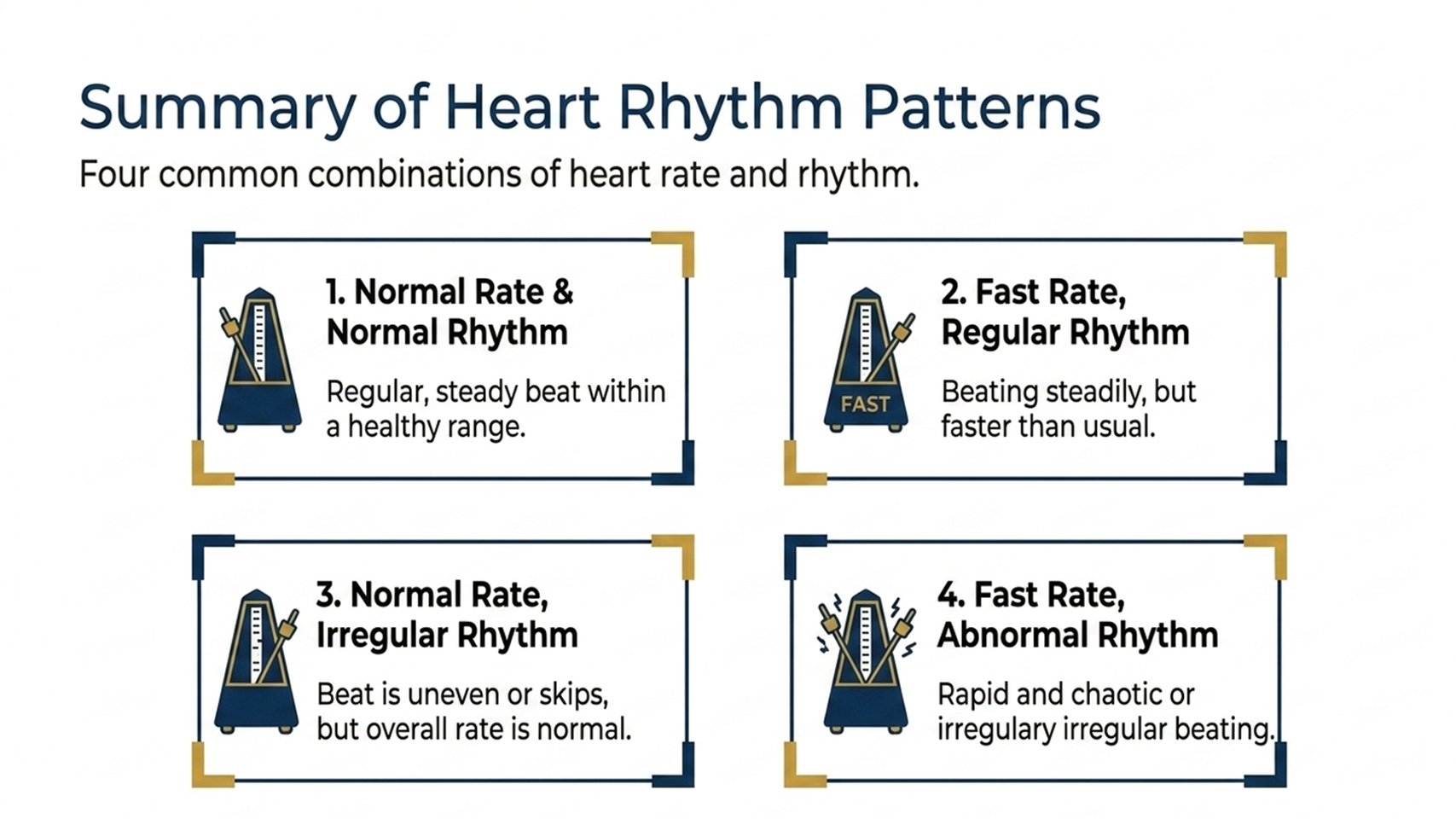
Normal rate, normal rhythm
- Your heart is beating at a normal speed with an even pattern.
- If it still feels unusually loud or noticeable to you, this is rarely a primary rhythm disorder.
- Usually driven by anxiety, anaemia, pregnancy, or a hormonal shift.
Fast rate, regular rhythm
- Your heart is beating quickly but steadily.
- Can be sinus tachycardia, often linked to anxiety, caffeine, or adrenaline.
- Can also be Supraventricular Tachycardia (SVT), a structural rhythm disorder that starts and stops abruptly, like a light switch.
- If it comes on specifically when you stand up, and settles when you sit or lie back down, this can point to POTS (Postural Orthostatic Tachycardia Syndrome), a genuine and often missed diagnosis, particularly in younger women.
Normal rate, irregular rhythm
- Occasional skips or jumps at a normal rate usually point to ectopic beats, extra beats that are common and usually harmless.
- A constant, disorganised irregularity at a normal rate can point to Atrial Fibrillation (AF) with a controlled rate.
Fast rate, abnormal rhythm
- Almost always active, uncontrolled Atrial Fibrillation.
- This pattern warrants medical assessment.
Why this matters: Matching your own experience to one of these four patterns is often more useful for your GP than the words “fluttering” or “racing” alone. Bring this description to your appointment, it genuinely helps guide investigation.
The Causes of Palpitations: Organic vs Functional
Causes of palpitations at a glance: now that you know the four patterns, here is what usually sits behind each one, and why.
Normal rate, normal rhythm, but feels loud
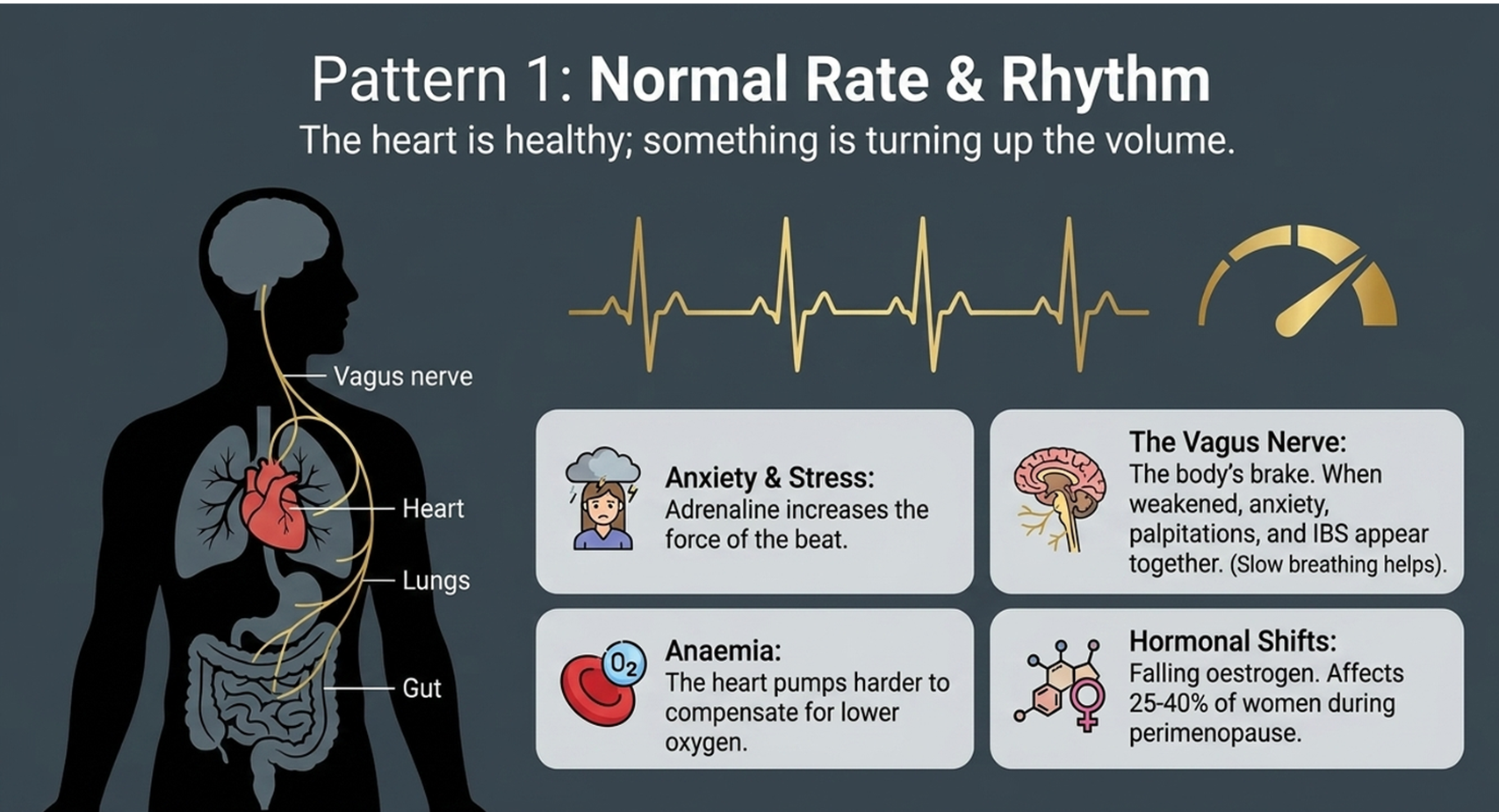
- Your heart is working exactly as it should, you are just unusually aware of it.
- Anxiety and stress are by far the most common reason. Under stress, your body releases adrenaline, which increases the force of each heartbeat even when the speed stays normal.
- The vagus nerve is often the real driver here. It acts as the body’s main brake on the nervous system, calming the heart, gut, and stress response together. When it isn’t functioning well, that brake weakens, and this is why anxiety, palpitations, and irritable bowel syndrome so often appear in the same person. It also explains why slowing your breathing, which directly stimulates the vagus nerve, can calm palpitations and gut symptoms at the same time.
- Anaemia can cause this too. With fewer red blood cells carrying oxygen, your heart pumps harder to compensate, which you may notice as a stronger beat.
- Pregnancy and hormonal shifts, including perimenopause and menopause, can produce the same sensation. Falling and fluctuating oestrogen affects the part of your nervous system that regulates heart rhythm, making a normal heartbeat feel more noticeable. Research has found palpitation complaints roughly double during perimenopause, affecting an estimated 25 to 40% of women during the transition.
- These are all functional causes. The heart itself is healthy, something else is turning up the volume on how it feels.
Fast rate, regular rhythm
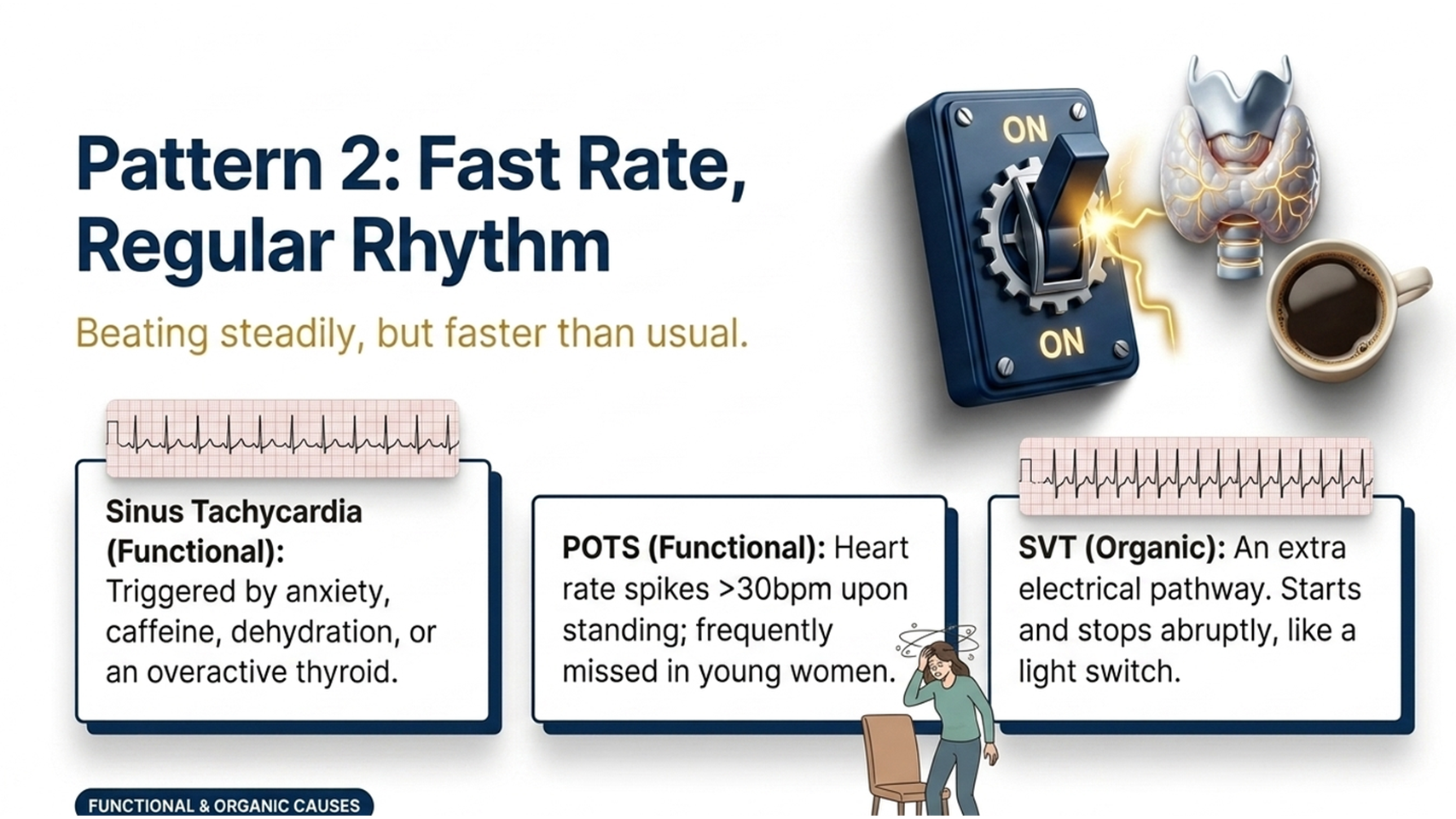
- Sinus tachycardia is the most common explanation, your heart simply beating faster than usual in a steady pattern. This is a functional cause, typically triggered by anxiety, caffeine, dehydration, or an overactive thyroid.
- An overactive thyroid speeds up your whole metabolism, including your heart rate. It is picked up on a simple blood test (TSH) and is treatable once identified.
- Caffeine and mild dehydration both push your heart rate up in the same way, by increasing sympathetic nervous system activity.
- POTS (Postural Orthostatic Tachycardia Syndrome) is a specific and genuine functional cause, where your heart rate rises sharply on standing, typically by more than 30 beats per minute, and settles again once you sit or lie down. It’s more common than many better known conditions, particularly in young women, but is frequently missed because it isn’t widely recognised in primary care.
- Supraventricular Tachycardia (SVT) is the organic cause in this category, caused by an extra electrical pathway in the heart that creates a short circuit. Unlike sinus tachycardia, SVT tends to start and stop abruptly, like a light switch, rather than speeding up and slowing down gradually.
Normal rate, irregular rhythm
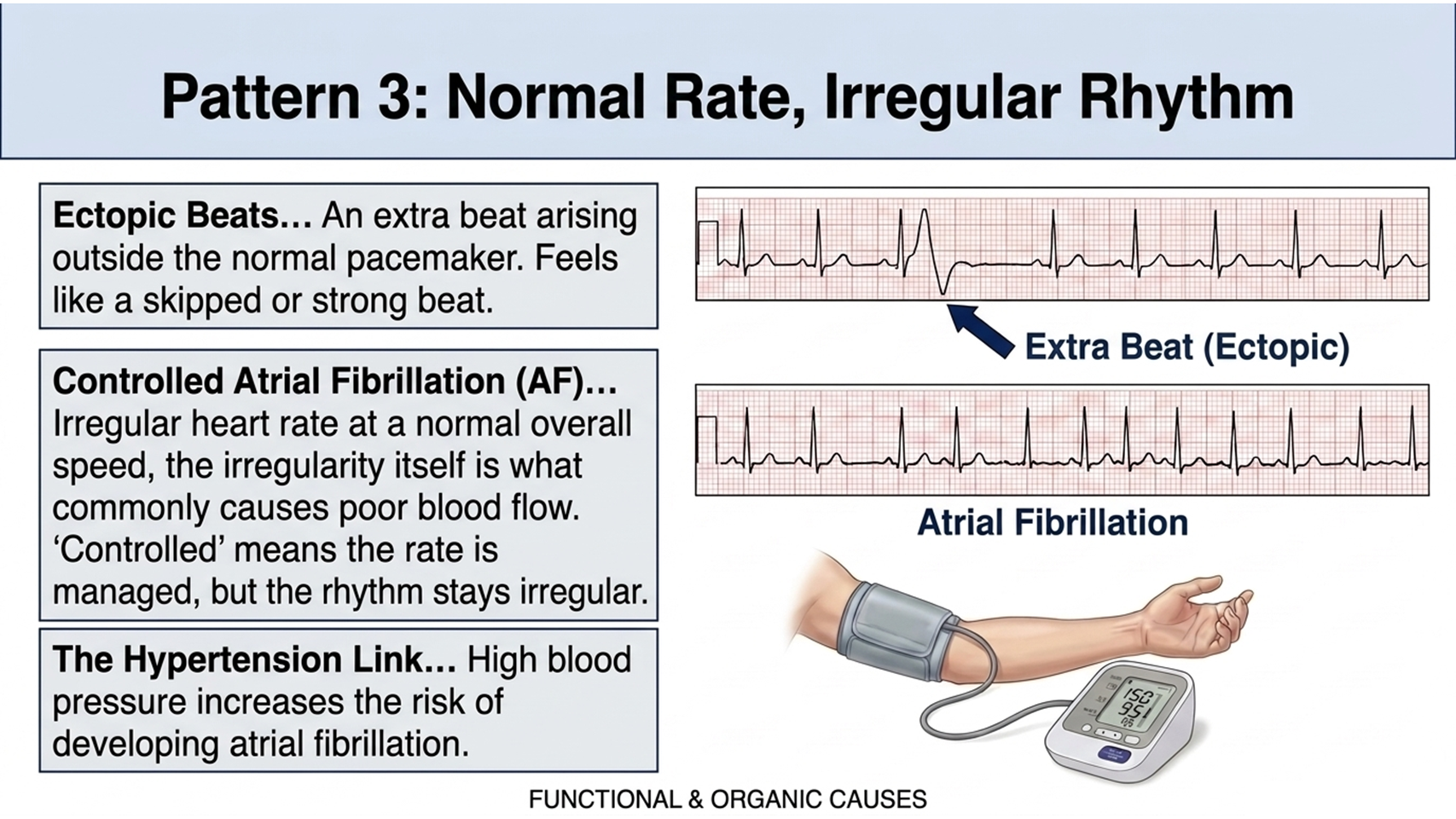
- Ectopic beats are the most common explanation, extra early beats that interrupt the normal pattern. Each one is usually followed by a short pause and then a noticeable thump, this is simply the next normal beat returning with a slightly larger volume of blood. Ectopics are an organic phenomenon, but a benign one, and are extremely common.
- Low magnesium can be a contributing factor when it’s genuinely deficient, correcting a confirmed deficiency has been shown to reduce ectopic activity. Routinely supplementing magnesium without testing first isn’t well supported by evidence, so this is worth checking rather than assuming.
- Atrial fibrillation with a controlled rate produces a constant, disorganised irregularity rather than occasional skips. This is also organic, and becomes more likely with age.
- Hypertension is present in over 70% of people with AF, and having hypertension raises your risk of developing AF by around 73%. This is why the two so often appear together in older adults. If you haven’t checked your own blood pressure recently, our guide on how to measure blood pressure at home correctly walks through getting an accurate seven day reading.
Fast rate, abnormal rhythm
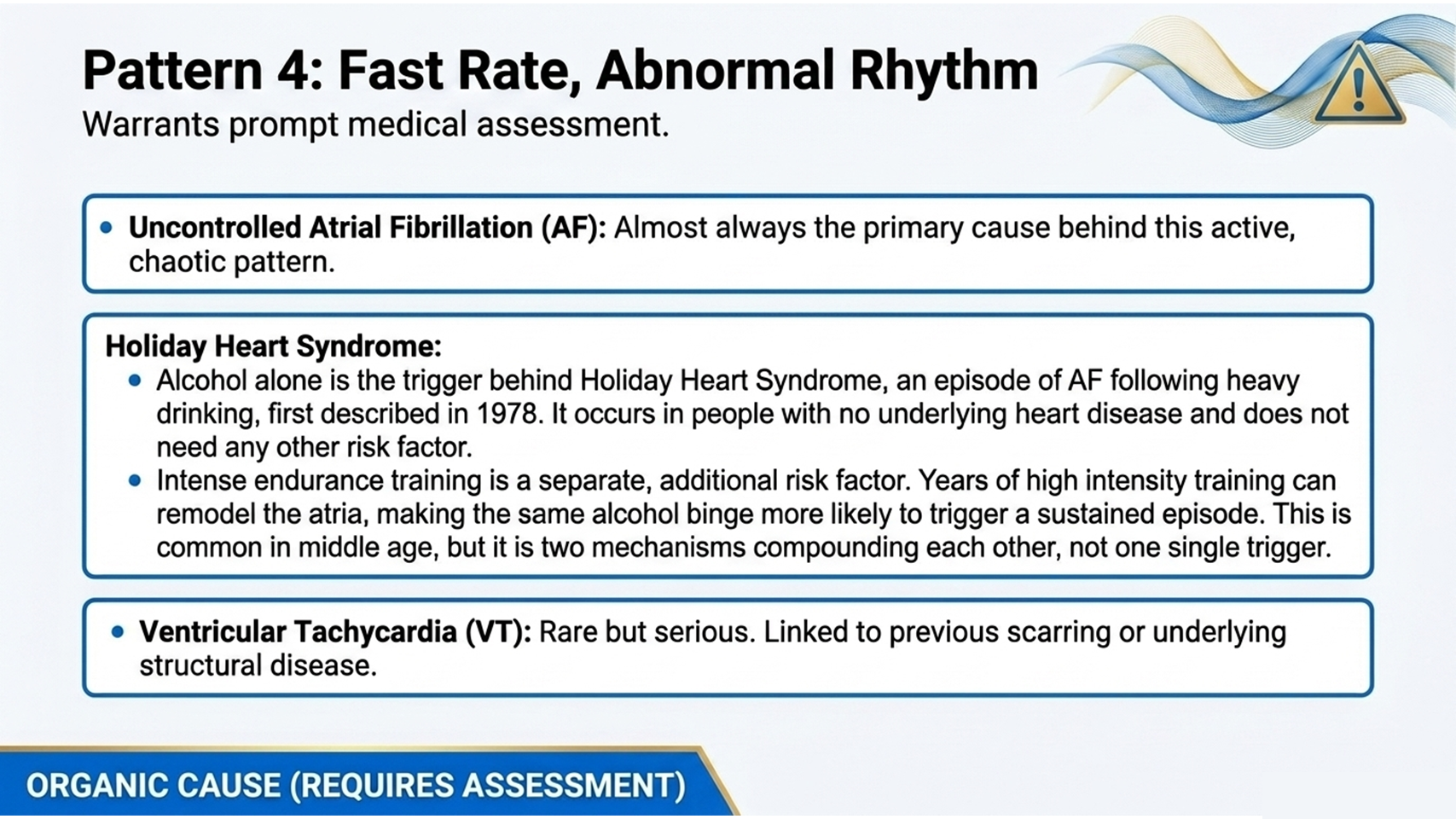
- This combination is almost always active, uncontrolled Atrial Fibrillation, an organic cause, and the pattern most likely to need prompt medical assessment.
- Alcohol is the well recognised trigger behind Holiday Heart Syndrome, an episode of AF or another fast, irregular rhythm following a bout of heavy drinking. First described in 1978 and now well established in medical literature, it occurs in people with no underlying heart disease. Alcohol’s effect on the heart’s electrical activity is dose dependent, so it does not need any other risk factor to happen on its own.
- Intense endurance exercise is a separate, additional risk factor, not part of Holiday Heart Syndrome itself. Years of high intensity training can gradually remodel the atria, making them more prone to electrical instability. This means the same alcohol binge is more likely to trigger a sustained episode in someone whose heart has been remodelled this way by training, compared with someone who isn’t particularly active.
- Middle age is a common time to see the two combine, since it often brings together years of endurance training and social drinking. But they are two separate mechanisms working together, not one single named condition.
- Unlike the persistent AF more common in older adults, Holiday Heart Syndrome typically resolves on its own once alcohol clears your system, and reflects a trigger rather than underlying heart disease. It’s a functional cause producing a temporary organic-pattern rhythm disturbance, not evidence of a structural heart problem.
- Ventricular Tachycardia (VT) is rare but serious, usually linked to scarring from a previous heart attack or underlying structural heart disease. It requires urgent assessment.
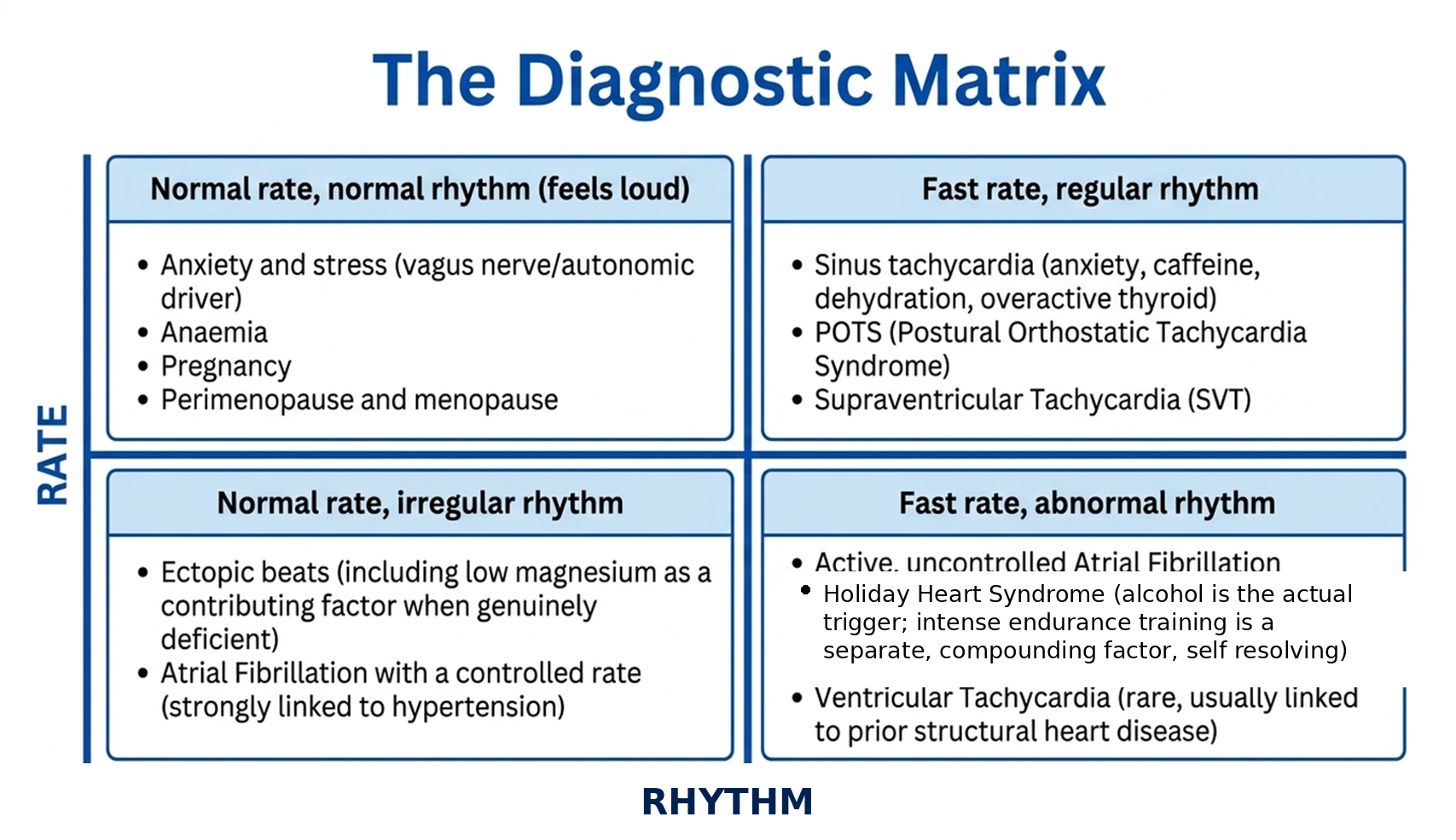
Why this matters: Once you know which of the four patterns matches your own experience, you already have a good idea of whether you are looking at a functional cause, something to manage and monitor, or an organic one, something that needs a formal diagnosis. Age is a useful guide too. Younger adults lean functional, middle age often means lifestyle factors like alcohol and training, and older adults, particularly with high blood pressure, lean organic.
Private specialist care, from one doctor
- Direct access to a Private Specialist GP, not a rotating team.
- Continuity that means nothing gets missed between appointments.
- Personalised care built around your full health picture, not just today’s symptom.
The Key Points
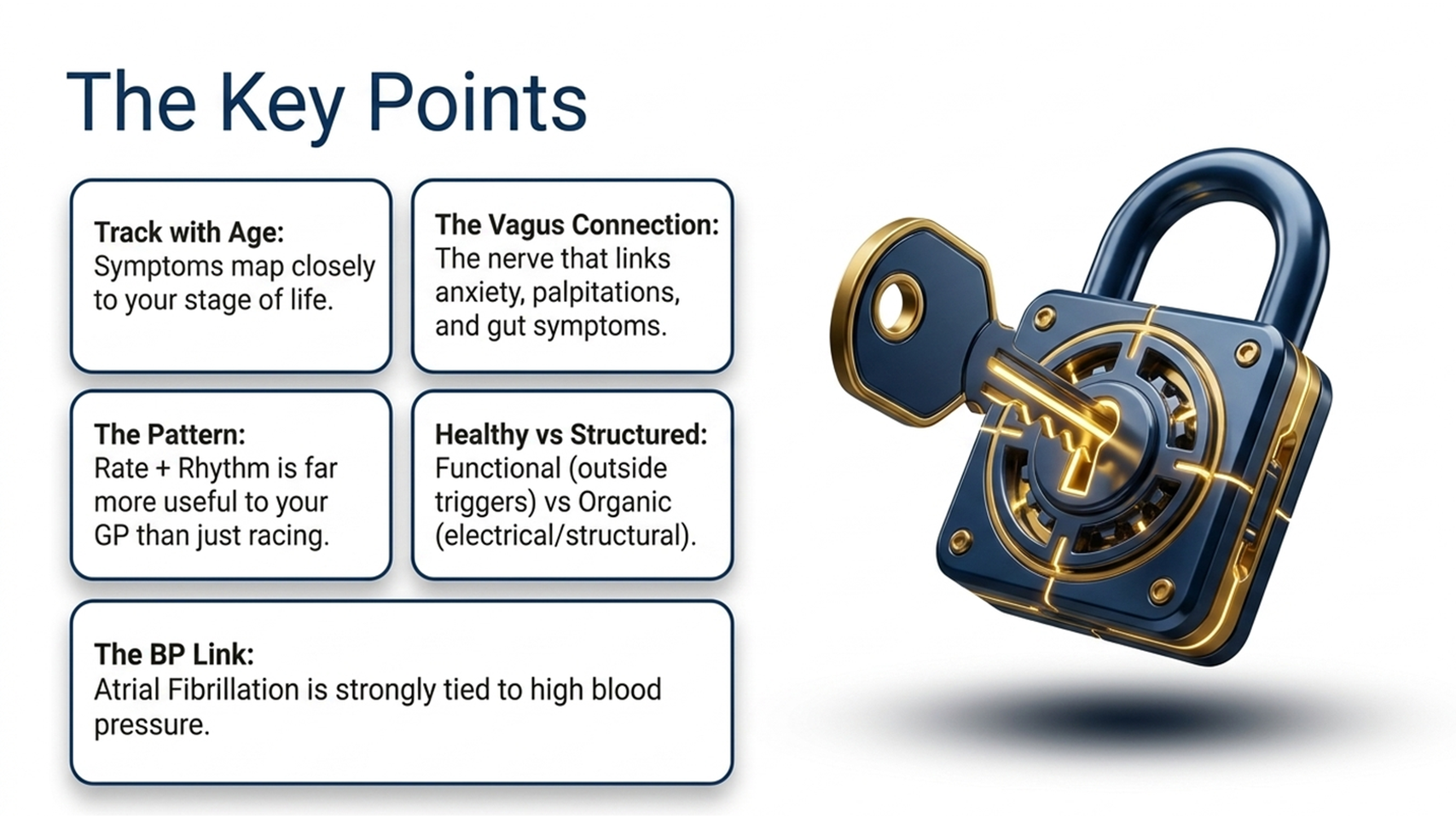
- Heart palpitations are one of the most common reasons people see a GP, and the likely cause usually tracks with age.
- Palpitations follow one of four patterns based on rate and rhythm, and describing your own experience this way helps guide diagnosis.
- The causes of palpitations fall into two groups, functional causes where the heart itself is healthy, and organic causes where the heart’s electrical or structural system is involved.
- The vagus nerve often links anxiety, palpitations, and gut symptoms like IBS together, and calming it through slower breathing can ease all three.
- Atrial fibrillation is strongly linked to high blood pressure and becomes more likely with age, though alcohol-triggered episodes in an otherwise healthy heart, known as Holiday Heart Syndrome, are usually temporary, and are more likely if you also have a history of intense endurance training.
- Certain symptoms alongside palpitations, particularly fainting or chest pain, need prompt medical assessment.
- Taking prescribed heart medication consistently is one of the most effective ways to prevent breakthrough symptoms.
Private specialist care, from one doctor
- Direct access to a Private Specialist GP, not a rotating team.
- Continuity that means nothing gets missed between appointments.
- Personalised care built around your full health picture, not just today’s symptom.
When Should You Worry?
Most palpitations are not dangerous, but certain features change that.
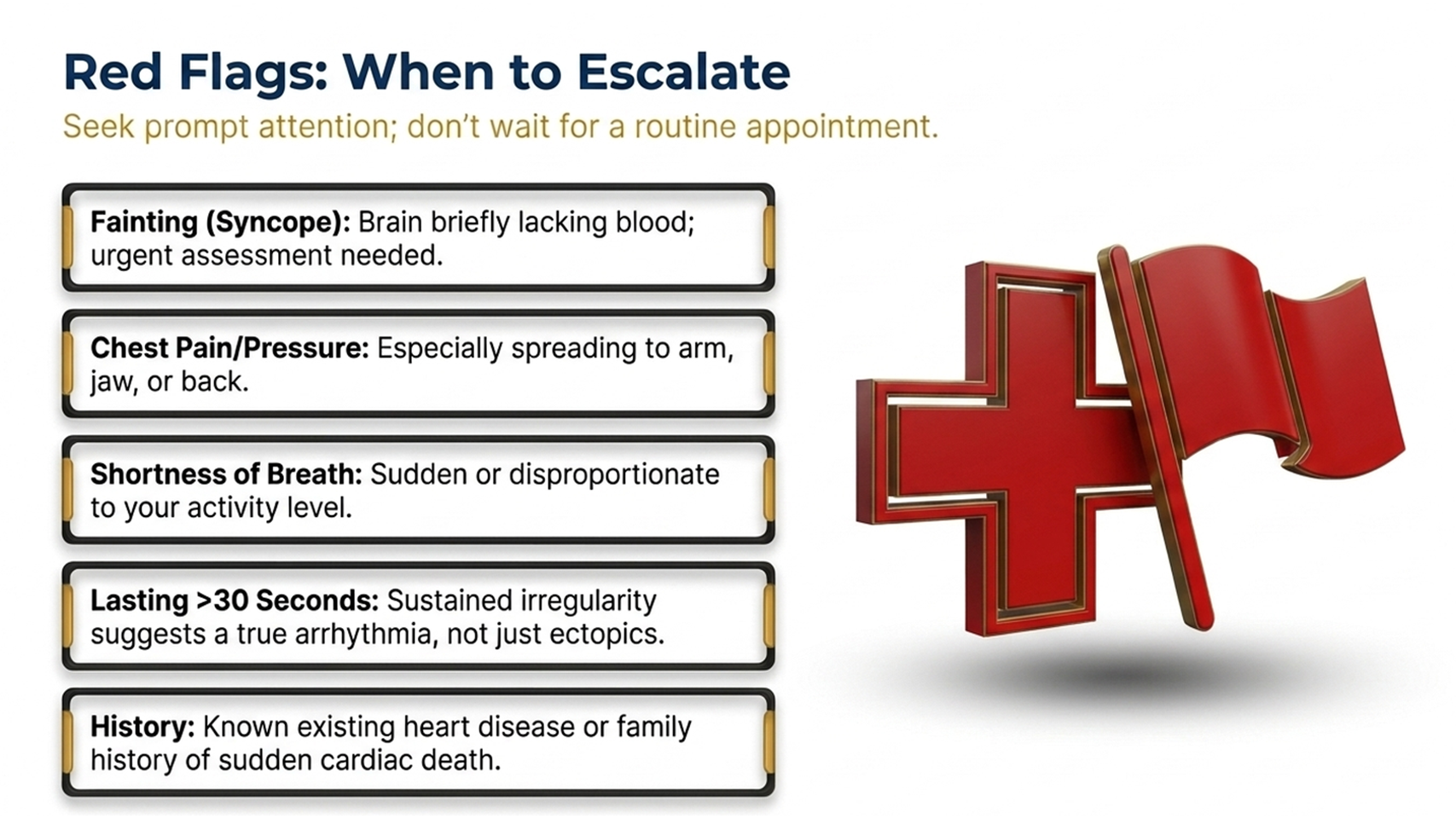
- Fainting or blacking out (syncope): This means your heart briefly failed to pump enough blood to your brain. Always requires urgent assessment, especially if it happens without warning or causes injury.
- Chest pain or pressure alongside the palpitations: Particularly if it spreads to your arm, jaw, or back.
- Significant shortness of breath: Especially if it comes on suddenly or is out of proportion to your activity.
- Palpitations lasting more than 30 seconds continuously: Short bursts of a few seconds are usually ectopic beats. A sustained irregular rhythm for longer than this is more likely to represent a true arrhythmia and should be checked.
- A family history of sudden cardiac death: This raises the importance of investigating even mild symptoms.
- New palpitations with known heart disease: Any new pattern in someone with existing structural heart disease warrants prompt review.
If any of these apply to you, seek medical attention promptly rather than waiting for your next routine appointment.
How Are Palpitations Managed?
Management depends on which pattern and cause apply to you, but a few principles apply broadly.
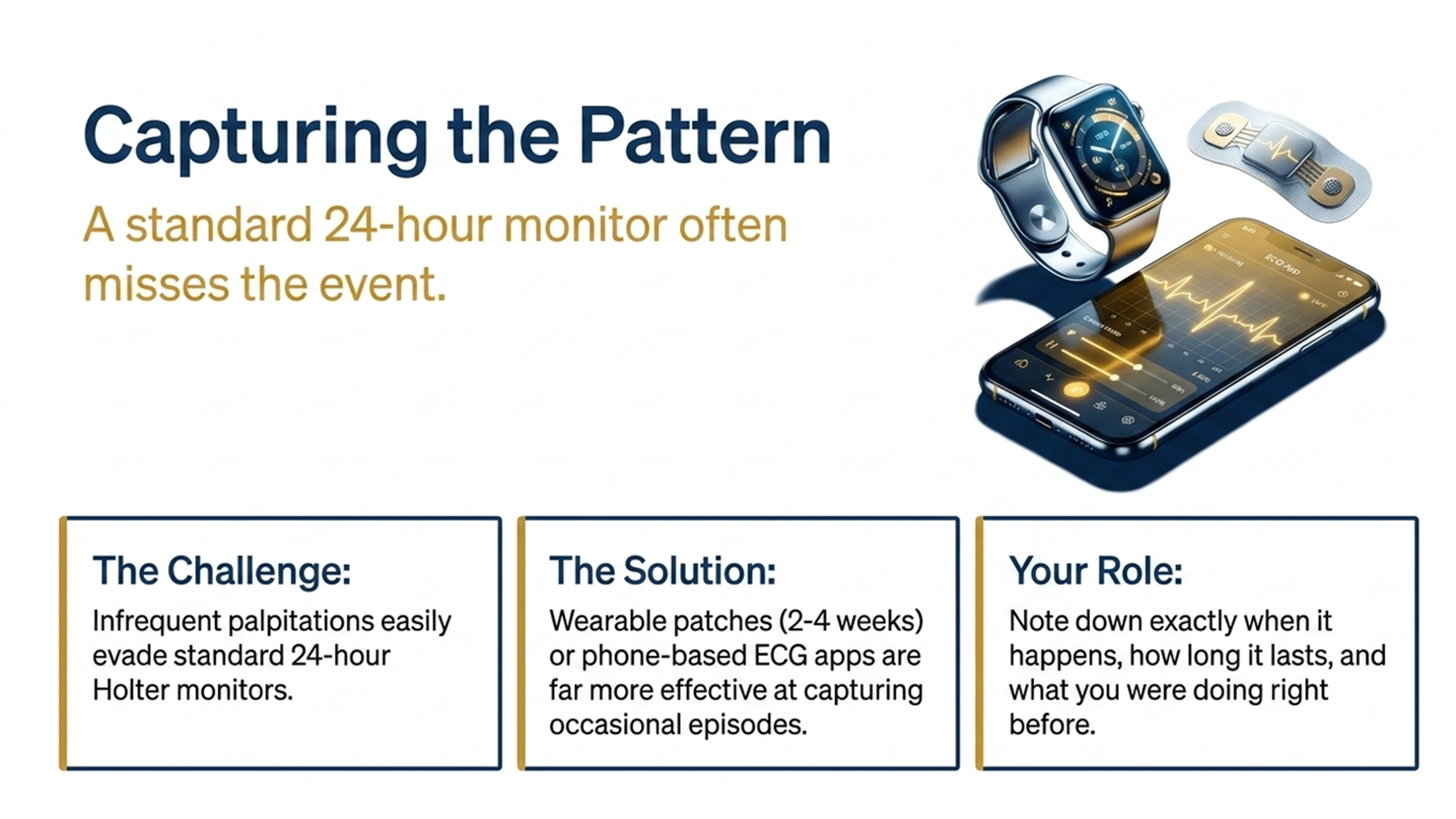
Getting the pattern captured
- A standard 24 hour Holter monitor is often unhelpful if your palpitations are infrequent, it can easily miss the episode entirely.
- Wearable patches worn for 2 to 4 weeks, or phone based ECG apps, are far more useful for capturing occasional episodes.
For functional causes
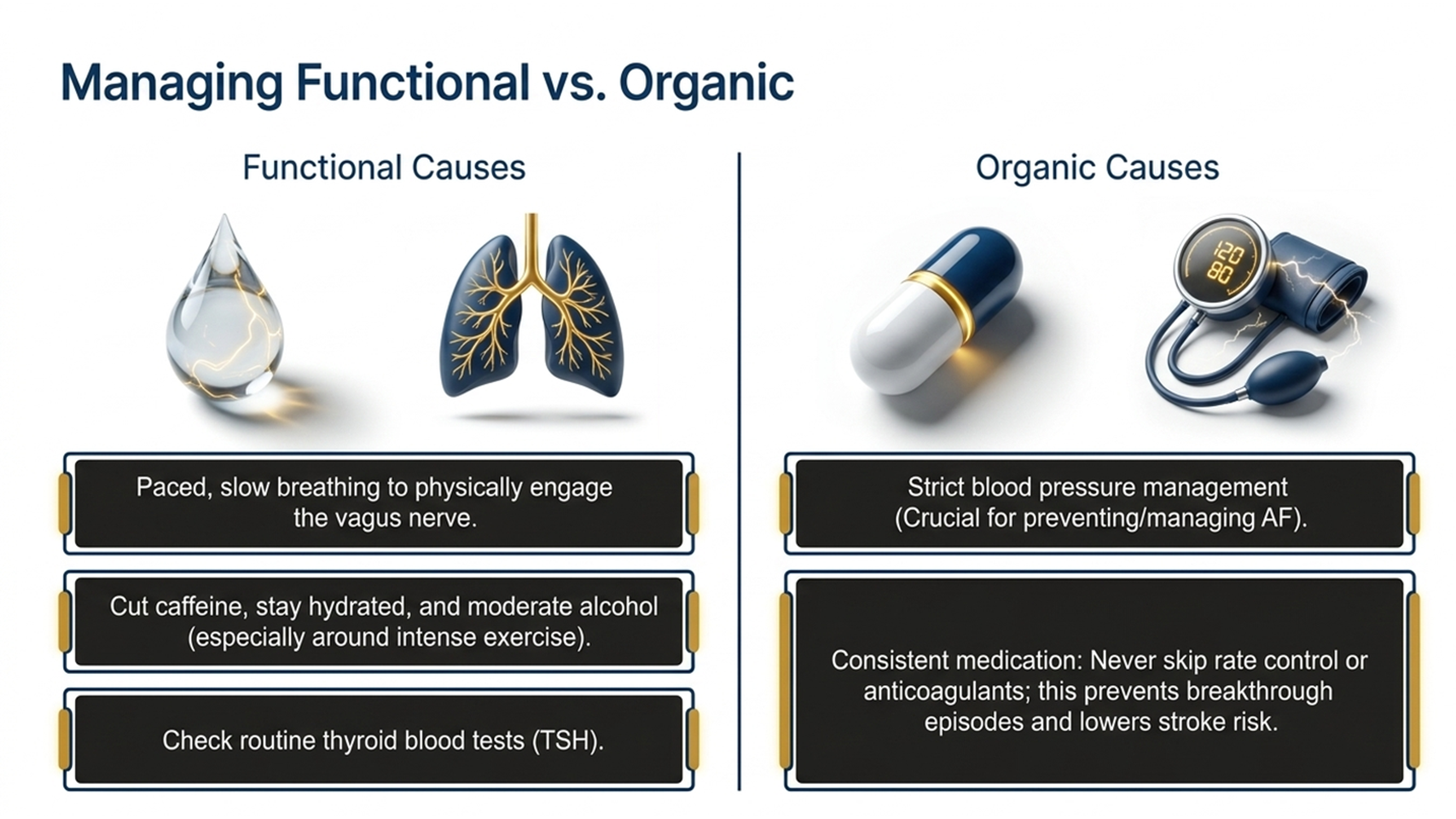
- Anxiety driven palpitations often respond well to slow, paced breathing, deliberately slowing your breathing rate helps calm the nervous system and reduce how forceful your heartbeat feels.
- Addressing the trigger directly helps too, cutting back caffeine, staying well hydrated, and moderating alcohol, particularly around intense exercise.
- A thyroid blood test should be checked if not already done, since this is a simple, treatable cause.
For organic causes, particularly Atrial Fibrillation
- Managing blood pressure well is one of the most effective things you can do, given how closely the two conditions are linked.
- Taking your prescribed medication consistently matters more in AF than in almost any other condition. Missing doses of rate control or anticoagulant medication can trigger breakthrough episodes and unnecessary anxiety about your heart, on top of raising your stroke risk. If you are struggling with your regimen, tell your GP rather than stopping quietly.
- Ectopic beats generally need reassurance rather than treatment, though persistent or very frequent ectopics should still be reviewed.
When to escalate
- Ongoing or worsening symptoms despite lifestyle changes, or any red flag from the previous section, should prompt a formal cardiology referral for a monitor and further testing.
What This Means For You
- If your palpitations feel loud but your rate and rhythm are normal, this is usually functional and rarely something to fear.
- Note down when your palpitations happen, how long they last, and what you were doing beforehand. This description is often more useful to your GP than you might think.
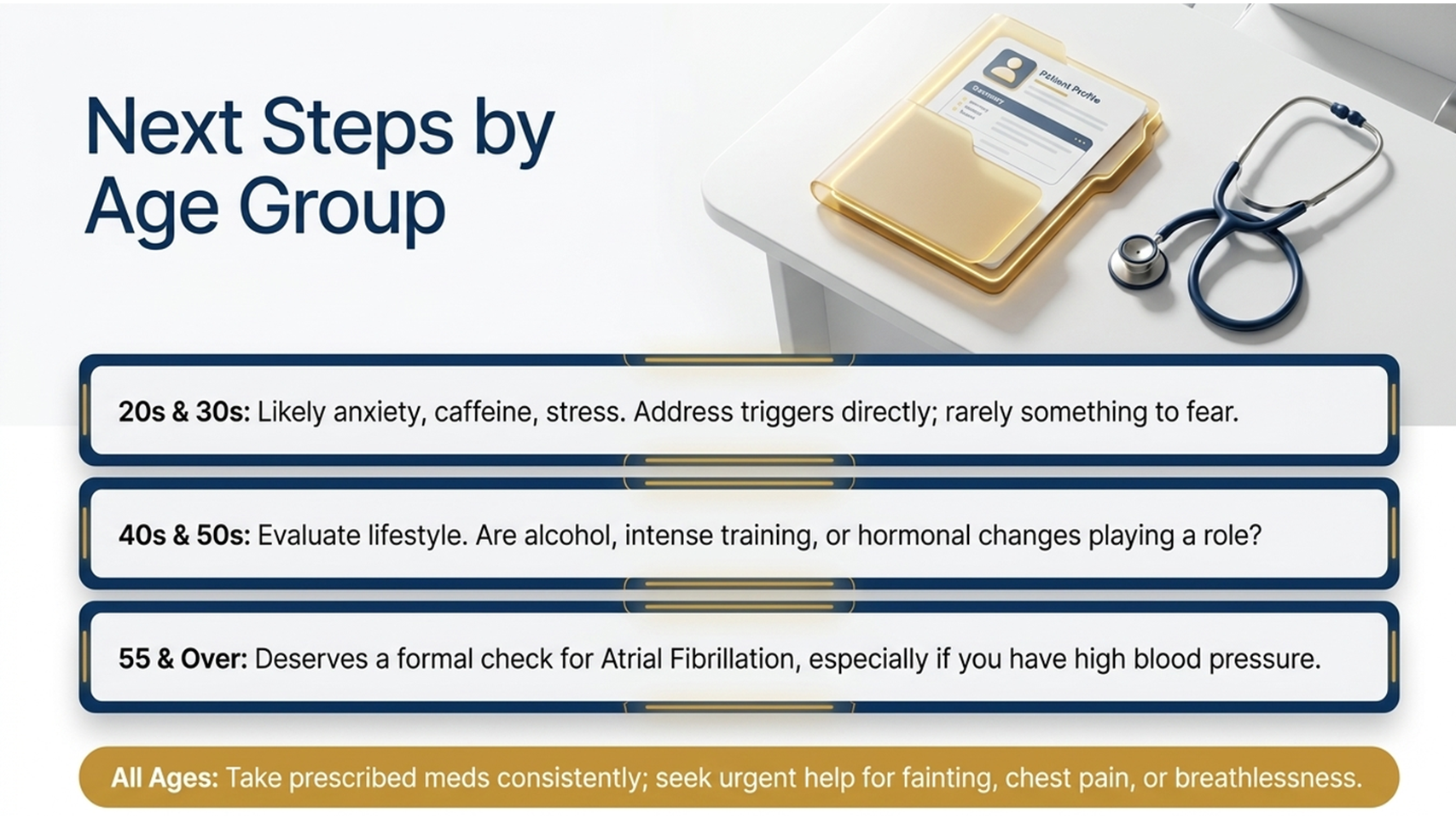
- If you are in your 20s or 30s, anxiety, caffeine, and stress are the most likely explanation, worth addressing directly rather than worrying about your heart itself.
- If you are in your 40s or 50s, consider whether alcohol, intense training, or hormonal changes could be playing a role, and remember that an alcohol-triggered episode does not necessarily mean underlying heart disease, particularly if you train hard, since training itself can add to your risk on top of the alcohol.
- If you are over 55, particularly with high blood pressure, palpitations deserve a formal check for atrial fibrillation.
- If you are on medication for a known heart rhythm condition, taking it consistently is one of the most effective ways to prevent breakthrough symptoms and reduce your risk.
- Any fainting, chest pain, or breathlessness alongside your palpitations needs prompt medical attention, not a wait and see approach.
Understanding the causes of palpitations you’re experiencing is often the first step to feeling less anxious about your heart. If you would like a formal assessment, including blood pressure review and rhythm monitoring where appropriate, IM Clinic offers direct access to a Private Specialist GP for this kind of investigation.
Author: Dr Imran Mughal, Private Specialist GP
Website: www.imclinic.co.uk
Book a consultation: Book here
References
1. Grosjean, S. et al. Risk Factors of a Serious Underlying Cause of Palpitations Among Patients Attending an Emergency Department. Annals of Emergency Medicine. 2026.
2. Weber, B.E. and Kapoor, W.N. Evaluation and Outcomes of Patients with Palpitations. American Journal of Medicine, cited in AAFP, Palpitations: Evaluation in the Primary Care Setting. 2017.
3. Ettinger, P.O. et al. Arrhythmias and the Holiday Heart, Alcohol-Associated Cardiac Rhythm Disorders. American Heart Journal. 1978.
4. Tonelo, D., Providencia, R. and Goncalves, L. Holiday Heart Syndrome Revisited After 34 Years. Arquivos Brasileiros de Cardiologia. 2013.
5. Guasch, E. and Mont, L. Diagnosis, Pathophysiology, and Management of Exercise Induced Arrhythmias. Nature Reviews Cardiology. 2016.
6. Manolis, A.J. et al. Hypertension and Atrial Fibrillation, A Frontier Review. Circulation, AHA Journals.
7. SIMETAP AF Study. Atrial Fibrillation Prevalence Rates and Association with Cardiovascular Kidney Metabolic Factors. Journal of Clinical Medicine.
8. Carpenter, J.S. et al. Palpitation Experiences Across the Menopause Transition, SWAN Heart Study. Indiana University School of Nursing.
9. Vernino, S. et al. Postural Orthostatic Tachycardia Syndrome, A Frequently Missed Diagnosis. The Journal for Nurse Practitioners. 2022.
10. Nakamura, K. et al. Treating Arrhythmias with Adjunctive Magnesium, Identifying Future Research Directions. European Heart Journal Cardiovascular Pharmacotherapy. 2017.
11. Khawaja, O. et al. A Pilot Randomized Trial of Oral Magnesium Supplementation on Supraventricular Arrhythmias. Nutrients. 2018.
12. Salvioli, B. et al. Autonomic Nervous System Dysfunction in Irritable Bowel Syndrome, Pathophysiology and Therapeutic Implications. Frontiers in Neuroscience. 2026.

We would love to hear your thoughts. A few things to keep in mind before you post: