


Why Does Weight Come Back After Stopping the Injections?
Weight coming back after stopping injections is one of the most common things patients tell me about. You lost weight. You felt better. Then you stopped the injection, and the weight started to return. There are real biological reasons this happens. Understanding them changes everything.
Your Body Has a Weight Thermostat, ‘The Adipostat’
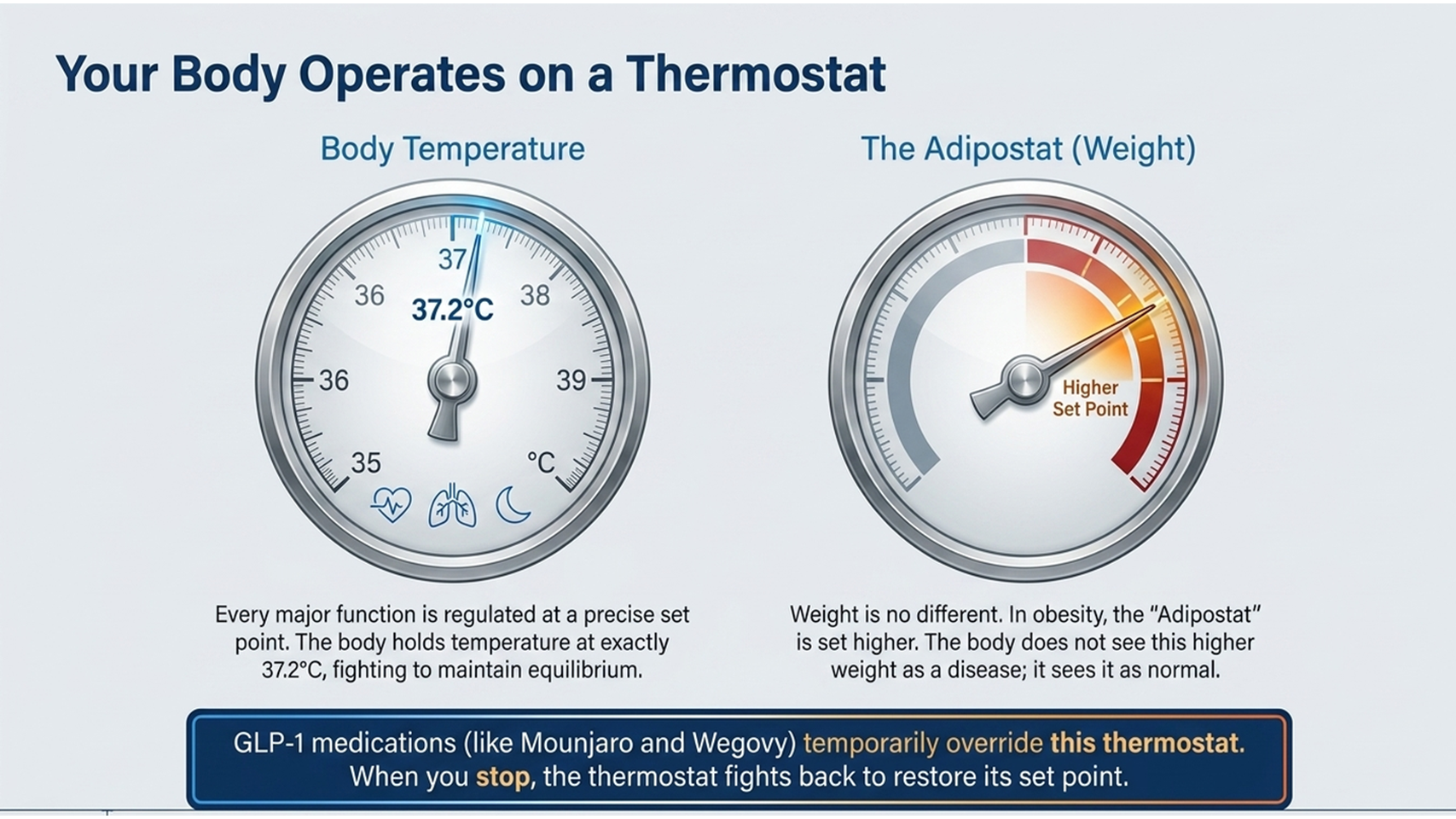
Think about how the body regulates temperature. It holds at 37.2 degrees. Not 37. Not 38. Precisely 37.2.
The same applies to:
- Heart rate
- Breathing
- Sleep patterns
Every major function in the body is regulated at a set point. The body will do everything it can to maintain that equilibrium.
Weight is no different.
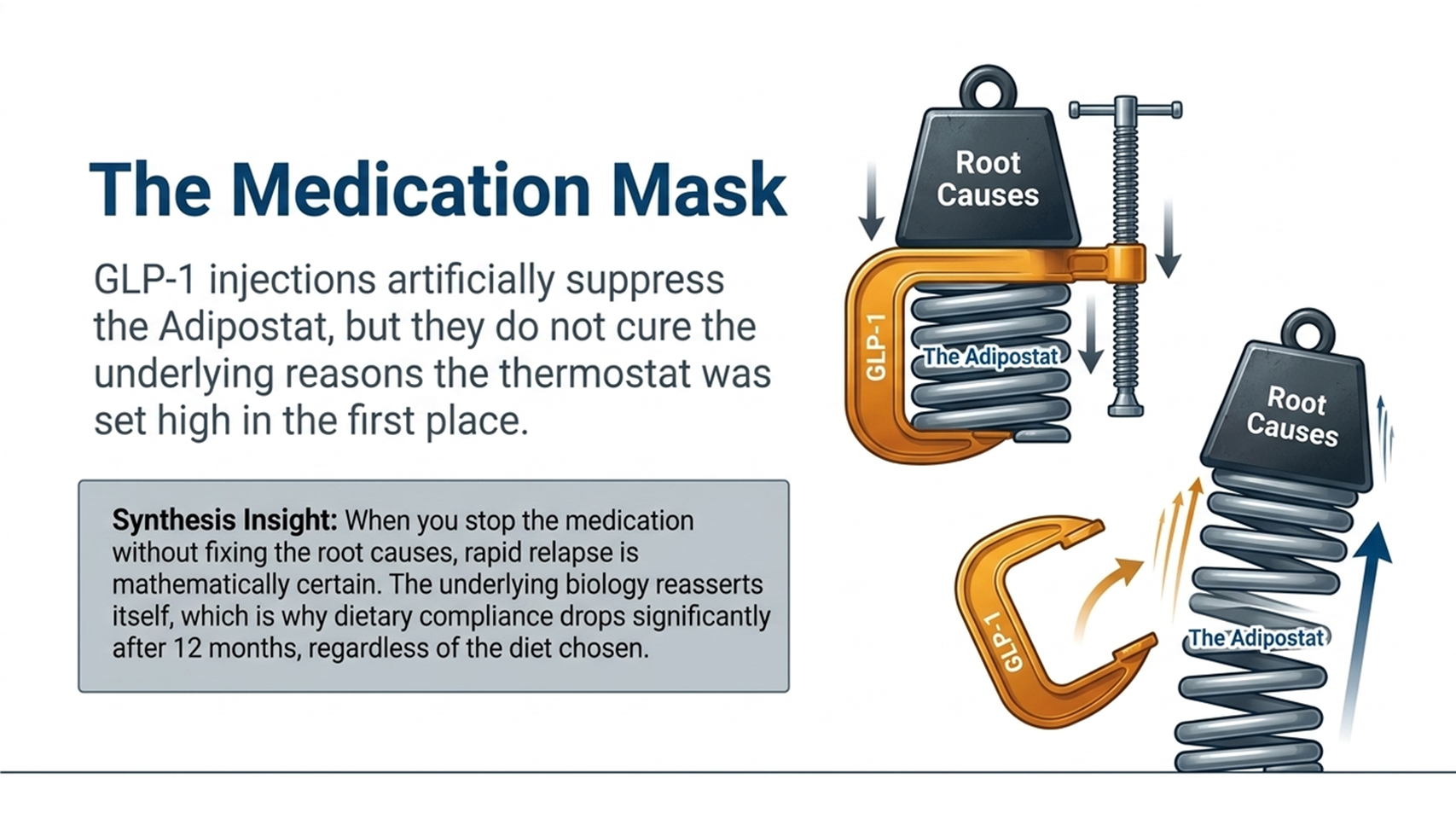
Your body has what we call an adipostat. Think of it as your weight thermostat.
In people with obesity, this thermostat has been set higher. The body does not see that higher weight as a problem. It sees it as normal. And it will fight to return to it.
GLP-1 medications like Mounjaro and Wegovy work by temporarily overriding this thermostat. When you stop, the thermostat fights back.
The Adipostat Is Controlled by Three Systems
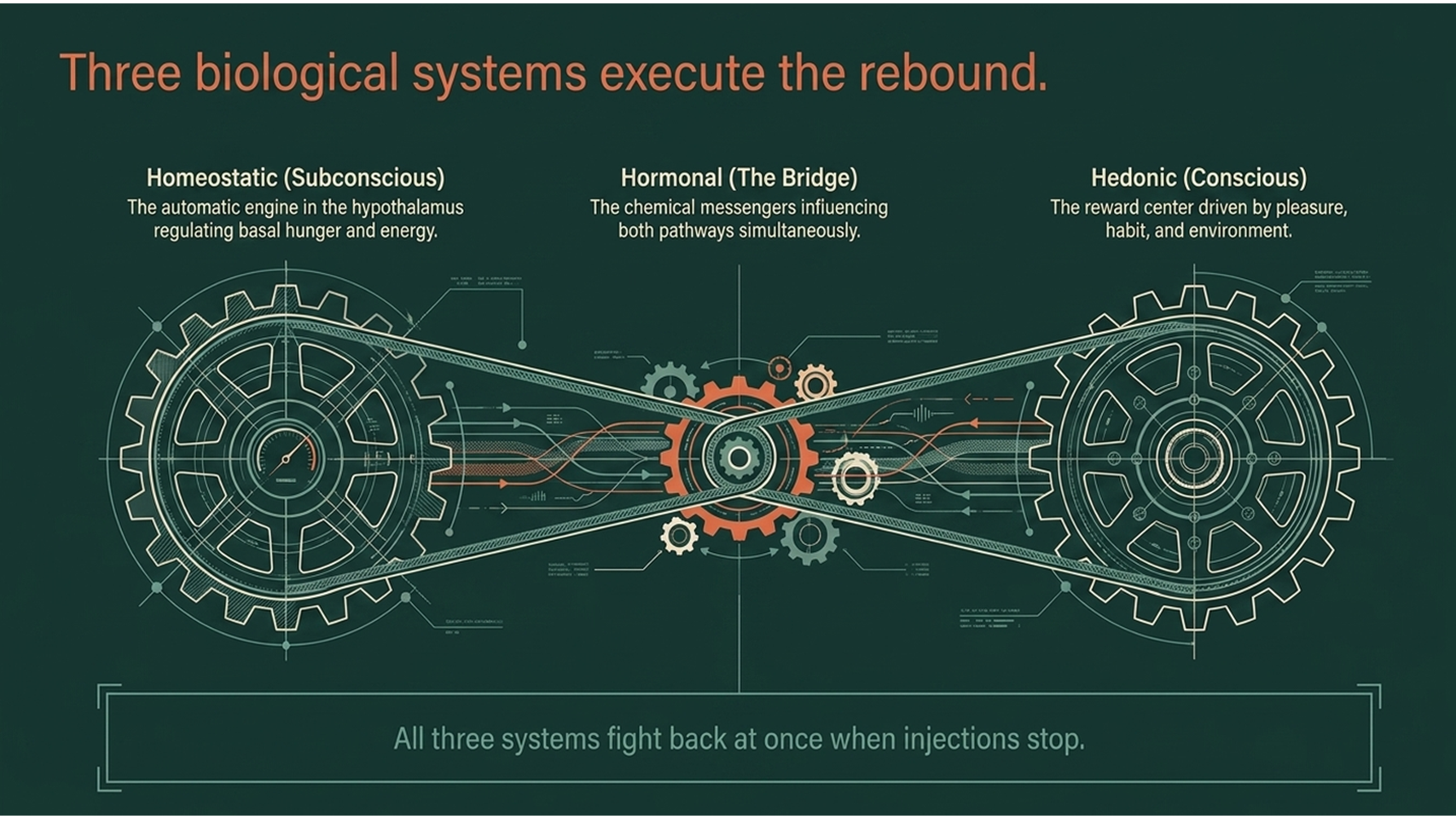
The homeostatic system
- This is the hypothalamus, the part of the brain that controls automatic body functions
- It is subconscious. You cannot control it directly
- It regulates hunger hormones, fullness signals, and energy expenditure without you being aware of it
- This is the primary driver of your weight set point
The hedonic system
- Hedonic means reward-driven
- This is the conscious, thinking brain, the cortex
- It is driven by reward, pleasure, emotion, habit, and environment
- The sight of food. The smell of it. Stress, boredom, grief, social situations
- This is the only system partially within your conscious control
- And it is powerful enough to override the other two
The hormonal system: the bridge between both
- Hormones influence both the homeostatic and the hedonic pathway simultaneously
- The homeostatic pathway is driven by ghrelin, leptin, insulin, GLP-1, PYY, and CCK
- The hedonic pathway is influenced by many of the same hormones, particularly ghrelin, leptin, GLP-1, and PYY
- This is why hormonal imbalances affect more than just hunger. They change how rewarding food feels
- And this is why willpower alone is never the answer
A note on genetics
Genetics influence all three systems simultaneously. Variants in genes such as FTO and MC4R affect how strongly the hypothalamus regulates hunger, how sensitive the brain’s reward centres are to food, and how efficiently hormones like leptin and insulin signal fullness. This means some people have a biologically stronger adipostat than others. It is not a character flaw. It is written into their biology from the start.
How the Adipostat Fights Back When You Stop
When you stop the injection, all three systems fight back at once.
The homeostatic system reactivates
- Hunger hormones rise
- Fullness signals weaken
- Metabolism slows and stays slow, burning fewer calories than before treatment
- Weight returns predominantly as fat rather than muscle, making the set point harder to shift
The hormonal system shifts against you
- Ghrelin rises sharply
- Leptin becomes less effective
- GLP-1 and PYY signals reduce after meals
- The gut empties faster, so fullness disappears more quickly after eating
- Every hormonal signal that was working in your favour now reverses
The hedonic system pulls harder
- Food becomes more rewarding
- The drive toward energy-dense, pleasurable food increases
- This is not a lack of willpower
- It is the reward centres of the brain responding to the loss of GLP-1’s influence
All three systems operate simultaneously. That is why weight coming back after stopping injections is so rapid and so predictable.
What the Trial Data Shows About Weight Coming Back After Stopping
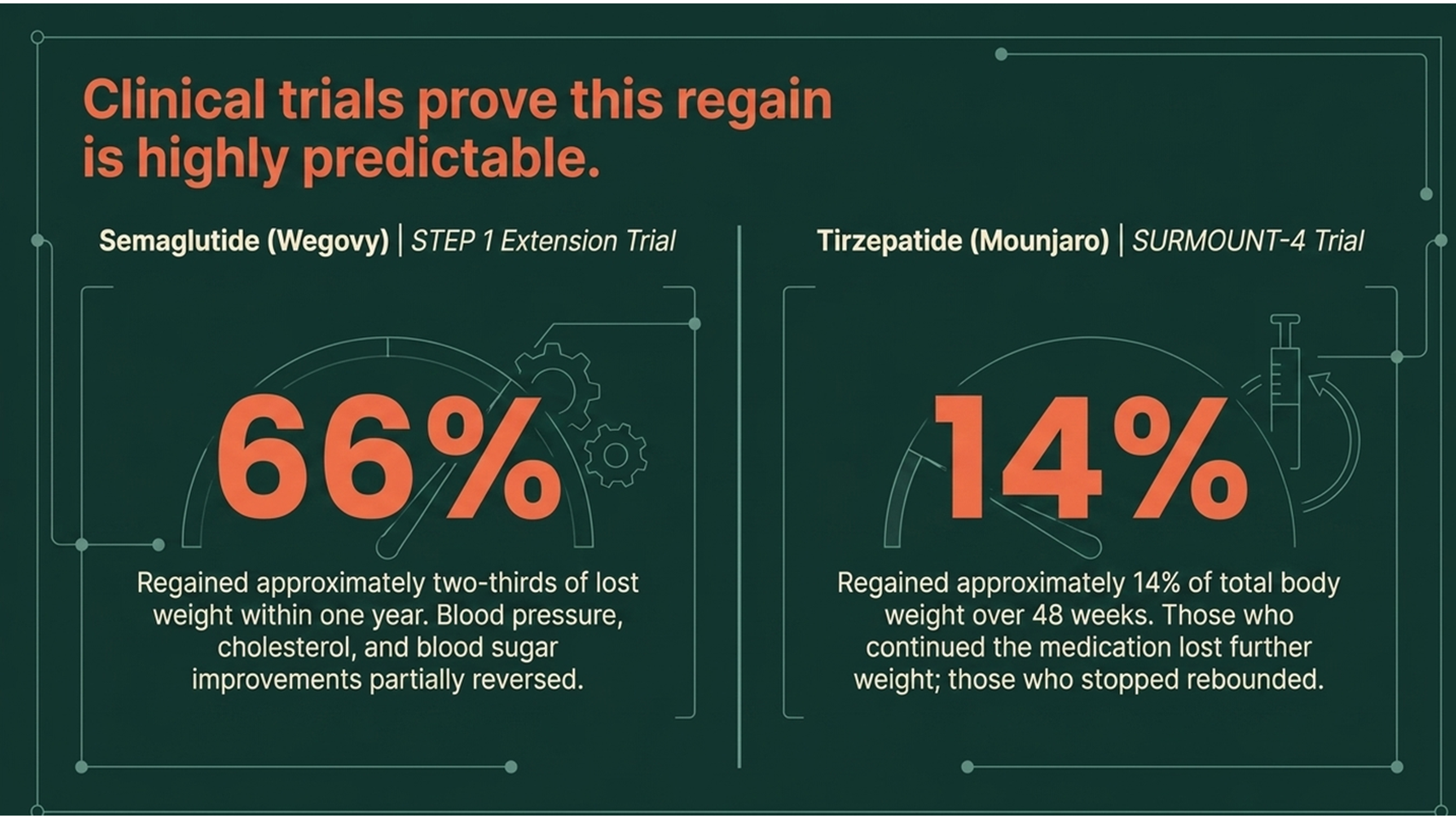
The numbers are clear. Across every GLP-1 medication studied, stopping the drug leads to significant weight regain.
| Drug | Trial | Outcome After Stopping |
|---|---|---|
| Semaglutide (Wegovy) | STEP 1 Extension | Regained approximately two thirds of lost weight within one year. Blood pressure, cholesterol, and blood sugar improvements also partially reversed. |
| Tirzepatide (Mounjaro) | SURMOUNT-4 | Regained approximately 14% of body weight over 48 weeks. Those who continued lost further weight. |
The pattern is consistent. Stop the drug, and the adipostat reasserts itself.
Newer medications like retatrutide are showing even greater weight loss in early trials. Cessation data is not yet available, but the same biological principles are expected to apply. You can read more in our post Retatrutide: The New Weight Loss Drug Everyone Is Talking About.
What Gets Left Behind: Treating the Person, Not Just the Obesity
The trial data explains what happens biologically. My clinical experience explains why some people struggle far more than others.
Obesity does not exist in isolation. Every organ and system in the body is connected. To treat obesity properly, we need to treat the whole person.
In my practice, the things most commonly left behind are:
| Root Cause | Why It Matters |
|---|---|
| Chronic inflammation and gut dysbiosis | Triggers systemic inflammation and directly disrupts weight regulation, independent of calorie intake |
| Hormonal imbalances | Hypothyroidism, insulin resistance, leptin resistance, and elevated cortisol all impair fat burning and fullness signalling |
| Sleep disorders | Obstructive sleep apnoea and poor sleep reduce leptin, increase ghrelin, and block physical recovery |
| Mental health and emotional drivers | Trauma, chronic stress, binge eating, and ADHD all affect the relationship with food at a neurological level |
| Mitochondrial dysfunction | Impairs cellular energy generation, causing chronic fatigue and cravings for energy-dense foods |
| Obesogenic medications | Many drugs for diabetes, hypertension, and mental health directly promote weight gain and are often overlooked |
| Environmental toxins | Certain chemicals disrupt endocrine pathways and push the adipostat set point higher over time |
There is also a pattern I see repeatedly. Compliance with dietary changes drops significantly after 12 months, regardless of which diet someone follows. This is not a lack of willpower. It is the underlying biology reasserting itself.
This is why a proper structured assessment before starting treatment matters. As I explain in What Actually Causes Obesity?, the drivers of obesity go far deeper than food choices alone.
Obesity Is a Chronic Condition, Not a Course of Treatment
Many people think of weight loss injections the way they think of antibiotics:
- You take them
- The problem is treated
- You stop
Obesity does not work like that.
NICE classifies obesity as a chronic, long-term condition requiring ongoing management. The same category as hypertension or type 2 diabetes.
If your blood pressure comes under control on medication, you do not stop and assume you are cured. The condition is being managed, not resolved. The same logic applies here.
Most people need some form of long-term support. That does not always mean a lifelong injection. But it does mean an ongoing plan:
- Regular clinical review and monitoring
- Medication adjustments over time
- Structured nutritional and lifestyle support
- Identifying and treating root causes that were missed at the start
The Key Points
- “The body has an adipostat, a weight thermostat, that actively fights to return to its previous higher setting when the injection stops”
- “Three systems drive this fight back simultaneously: the homeostatic system, the hormonal system, and the hedonic system. Genetics influence how strongly all three operate.”
- “Conditions like gut dysbiosis, hormonal imbalance, sleep disorders, and mental health drivers are often left unaddressed and significantly increase the risk of relapse”
- “Obesity is a chronic condition like hypertension or diabetes, and most people need some form of long-term management and support, not a fixed course of treatment”
What This Means For You
If you have stopped your injection and noticed weight returning, this is not a personal failure. It is your adipostat doing exactly what it was designed to do.
If you are thinking about stopping your medication, the question is not just when to stop. It is:
- What are my underlying root causes?
- Have they been properly assessed and addressed?
- What does my long-term plan look like?
At IM Clinic, we do not just treat the obesity. We treat the whole person. That means:
- A structured assessment of your individual root causes
- Addressing them directly alongside any medication
- Building a long-term plan for sustained results
If you would like to talk through your situation, you are welcome to book a consultation.
Dr Imran Mughal
Private Specialist GP | IM Clinic
Book a consultation
References
Wilding JPH et al. Weight regain and cardiometabolic effects after withdrawal of semaglutide: the STEP 1 trial extension. Diabetes Obes Metab. 2022. https://doi.org/10.1111/dom.14725
Aronne LJ et al. SURMOUNT-4 randomized clinical trial. JAMA. 2024. https://doi.org/10.1001/jama.2023.24945
Lisco G et al. Weight Regain After GLP-1 Interruption. J Clin Med. 2025. https://doi.org/10.3390/jcm14113791
eClinicalMedicine / The Lancet. Trajectory of weight regain after cessation of GLP-1 receptor agonists. 2026. https://www.thelancet.com/journals/eclinm/article/PIIS2589-5370(26)00043-X/fulltext
NICE. Overweight and obesity management. NG246. 2025. https://www.nice.org.uk/guidance/ng246
Sumithran P et al. Long-term persistence of hormonal adaptations to weight loss. N Engl J Med. 2011. https://doi.org/10.1056/NEJMoa1105816


We would love to hear your thoughts. A few things to keep in mind before you post: