


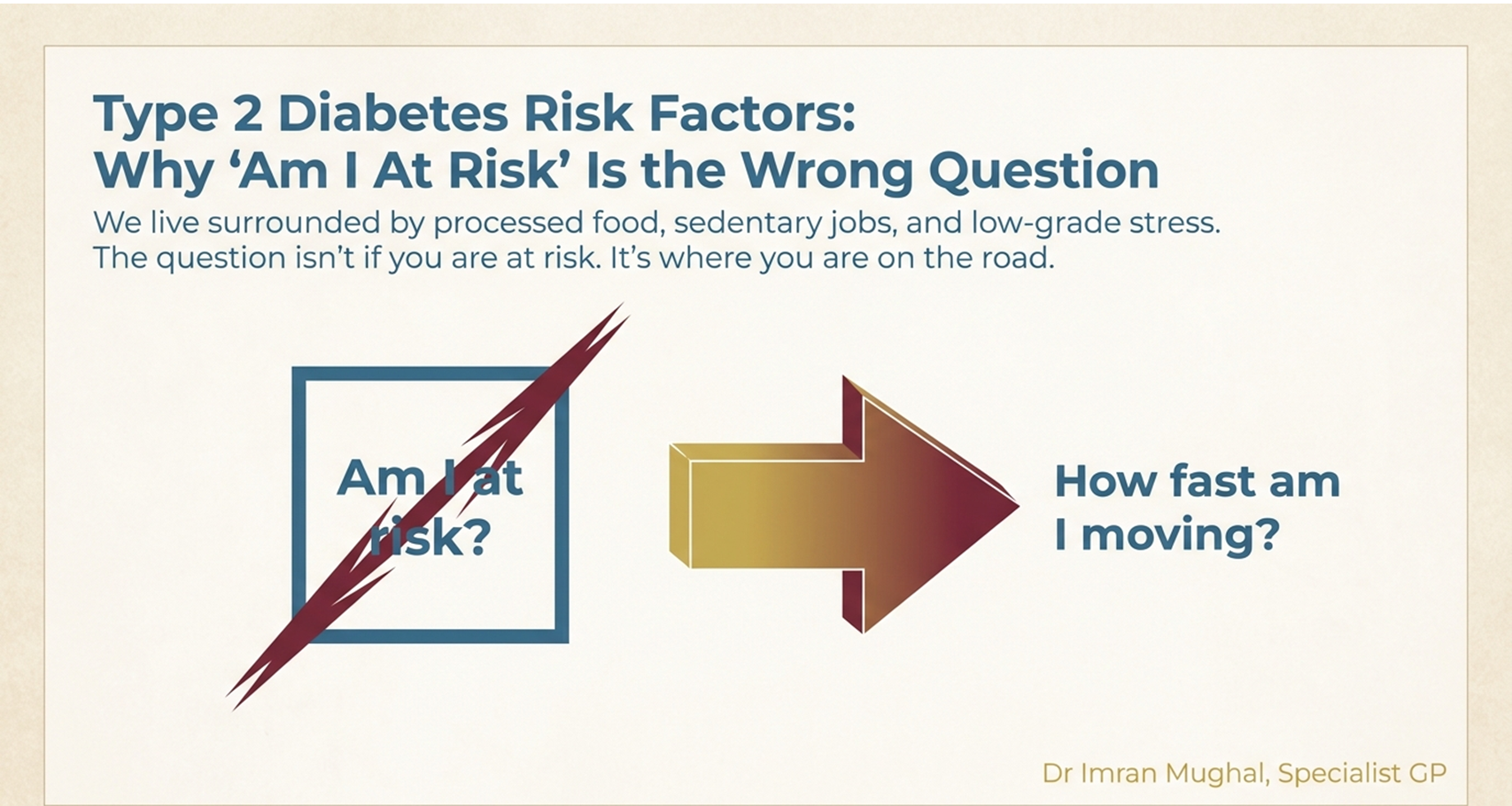
Type 2 Diabetes Risk Factors: Why “Am I At Risk” Is the Wrong Question
- We live surrounded by processed food, sedentary jobs, and constant low-grade stress.
- This is not a passing trend. It is the environment most of us live in every day now.
- Every year spent in that environment nudges the body a little further towards insulin resistance.
- The honest question is not “am I at risk of type 2 diabetes.” It is “how far along that road am I already, and how fast am I moving?”
- This post covers the established type 2 diabetes risk factors, why being told you are “low risk” does not mean you are safe forever, and one important exception worth knowing about.
What Is Actually Happening in the Body
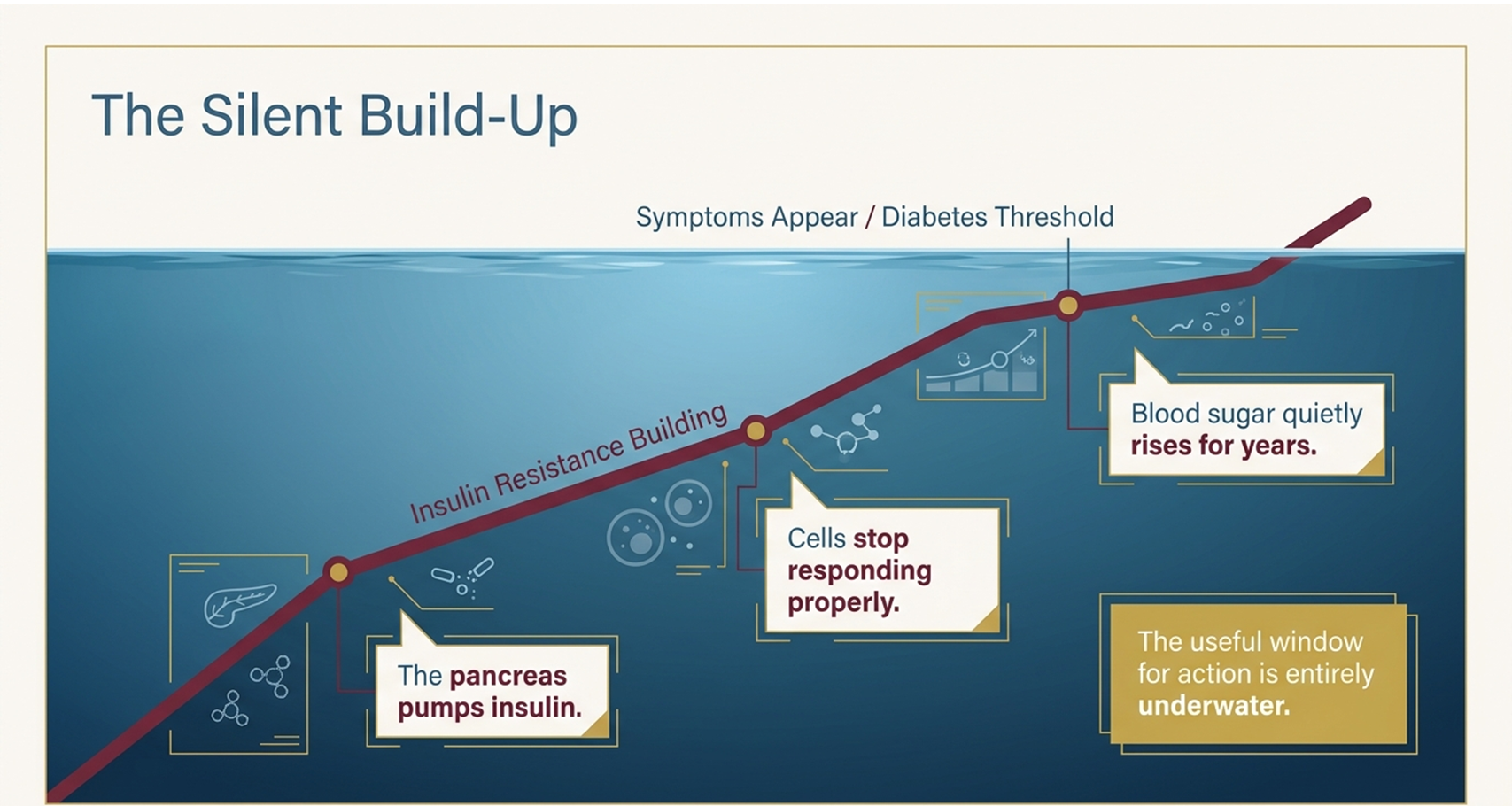
- Type 2 diabetes does not appear overnight. It builds slowly through insulin resistance.
- The pancreas produces insulin, but the body’s cells stop responding to it properly.
- Blood sugar rises gradually, often years before any symptoms appear.
- By the time fasting glucose or HbA1c crosses the diabetes threshold, the process has usually been running quietly for a long time.
- This is why waiting for symptoms is the wrong strategy. The useful window is earlier than most people think.
Type 2 Diabetes Risk Factors You Cannot Change
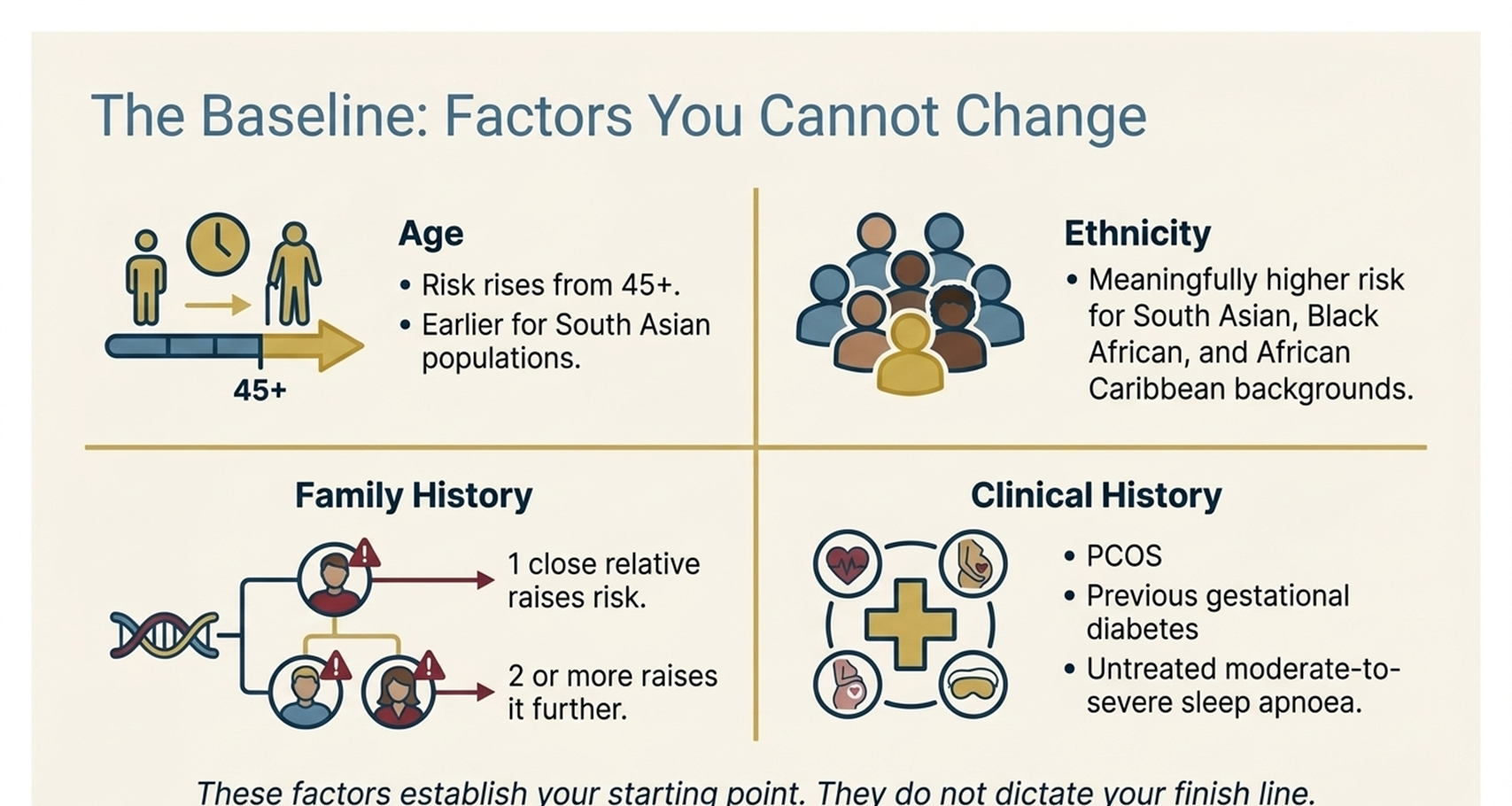
- Age. Risk rises from 45 onwards, earlier in South Asian populations.
- Ethnicity. South Asian, Black African, and African Caribbean backgrounds carry meaningfully higher risk.
- Family history. 1 close relative with type 2 diabetes raises risk. 2 or more raises it further.
- Reproductive and clinical history. PCOS, a previous diagnosis of gestational diabetes, and untreated moderate to severe sleep apnoea are all recognised risk factors, even in individuals who otherwise look low risk on paper.
Type 2 Diabetes Risk Factors You Can Influence
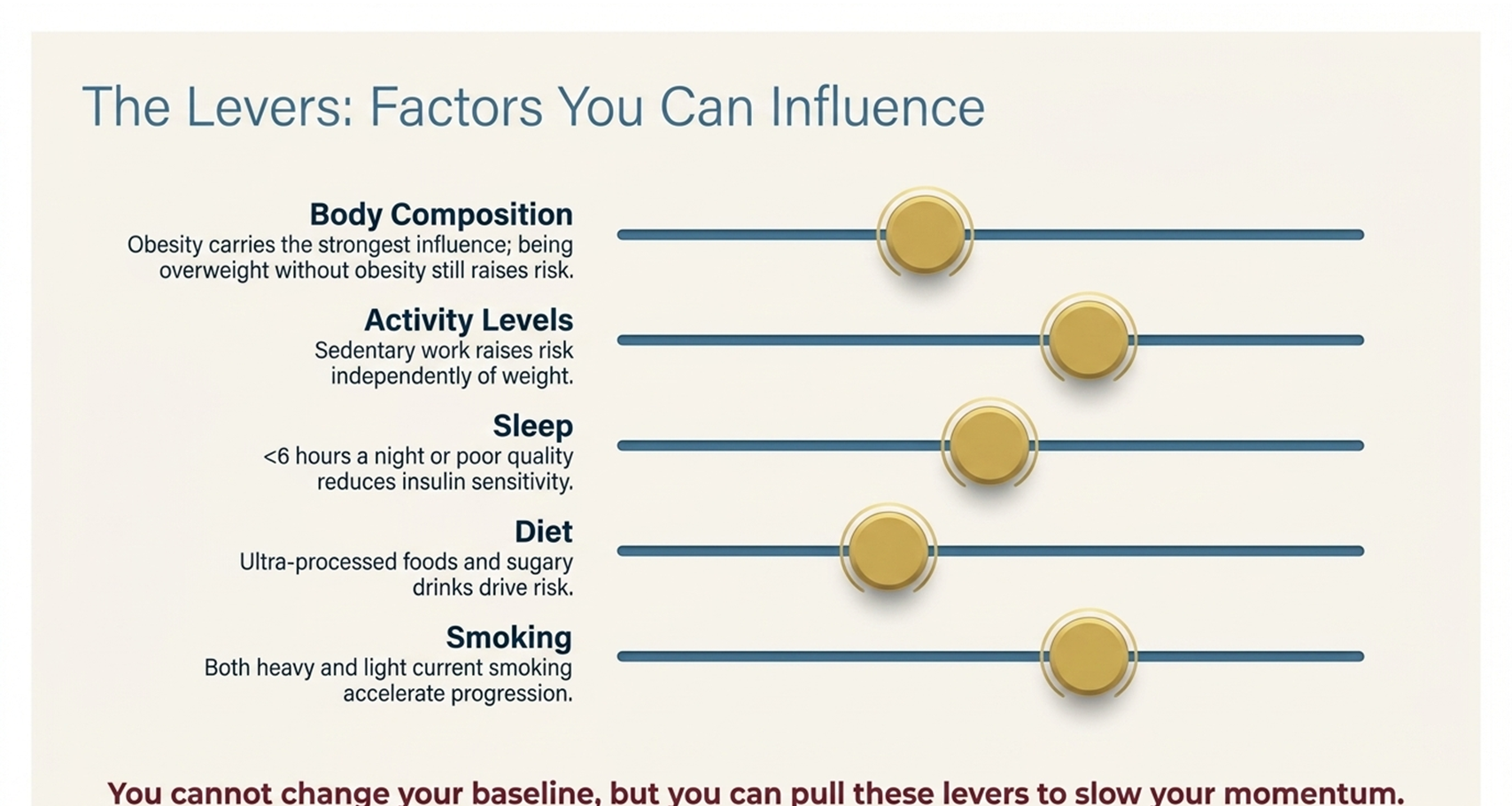
- Body composition. Obesity carries the strongest single influence, but being overweight without reaching obesity still raises risk meaningfully.
- Activity levels. Sedentary work and very low activity both independently raise risk, even in individuals who are not overweight.
- Sleep. Short sleep, under 6 hours a night, and poor sleep quality are both linked to worse insulin sensitivity.
- Diet. A diet high in ultra-processed food and regular sugary drinks is consistently linked to higher risk.
- Smoking. Both heavy and light current smoking raise risk.
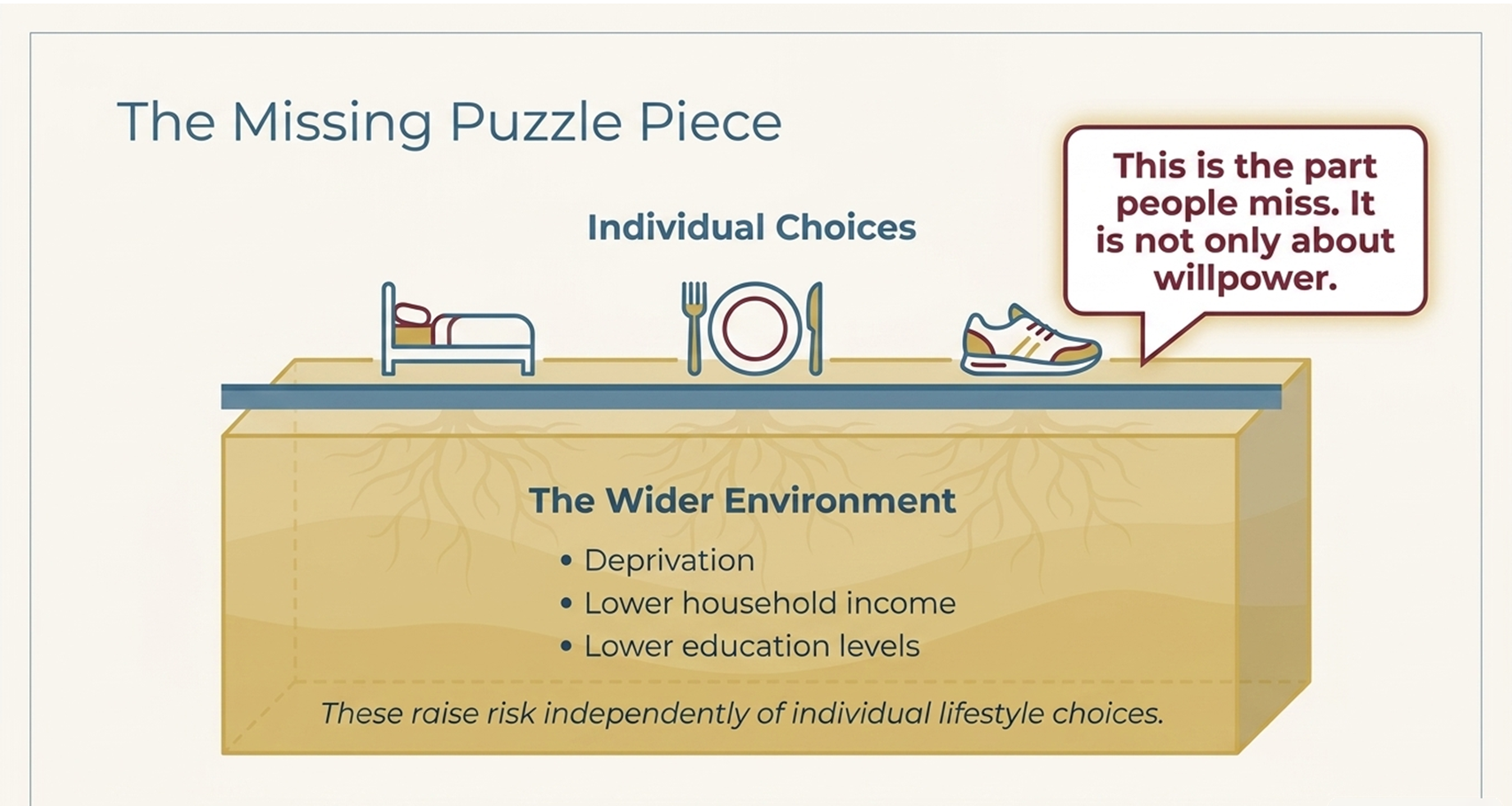
- Wider environment. Deprivation, lower household income, and lower education level are all independently associated with higher risk, regardless of individual lifestyle choices. This is the part people often miss. It is not only about willpower.
Why see the same doctor every time?
- One GP, start to finish. Dr Imran Mughal follows your risk profile and results over time, not a different clinician reviewing you from scratch each visit.
- Your results in context. HbA1c and risk factors are reviewed against your own history, not read in isolation.
- A plan that adapts. Prevention advice changes as your risk changes, not a one-size leaflet.
Why “Low Risk” Today Does Not Mean Safe Forever
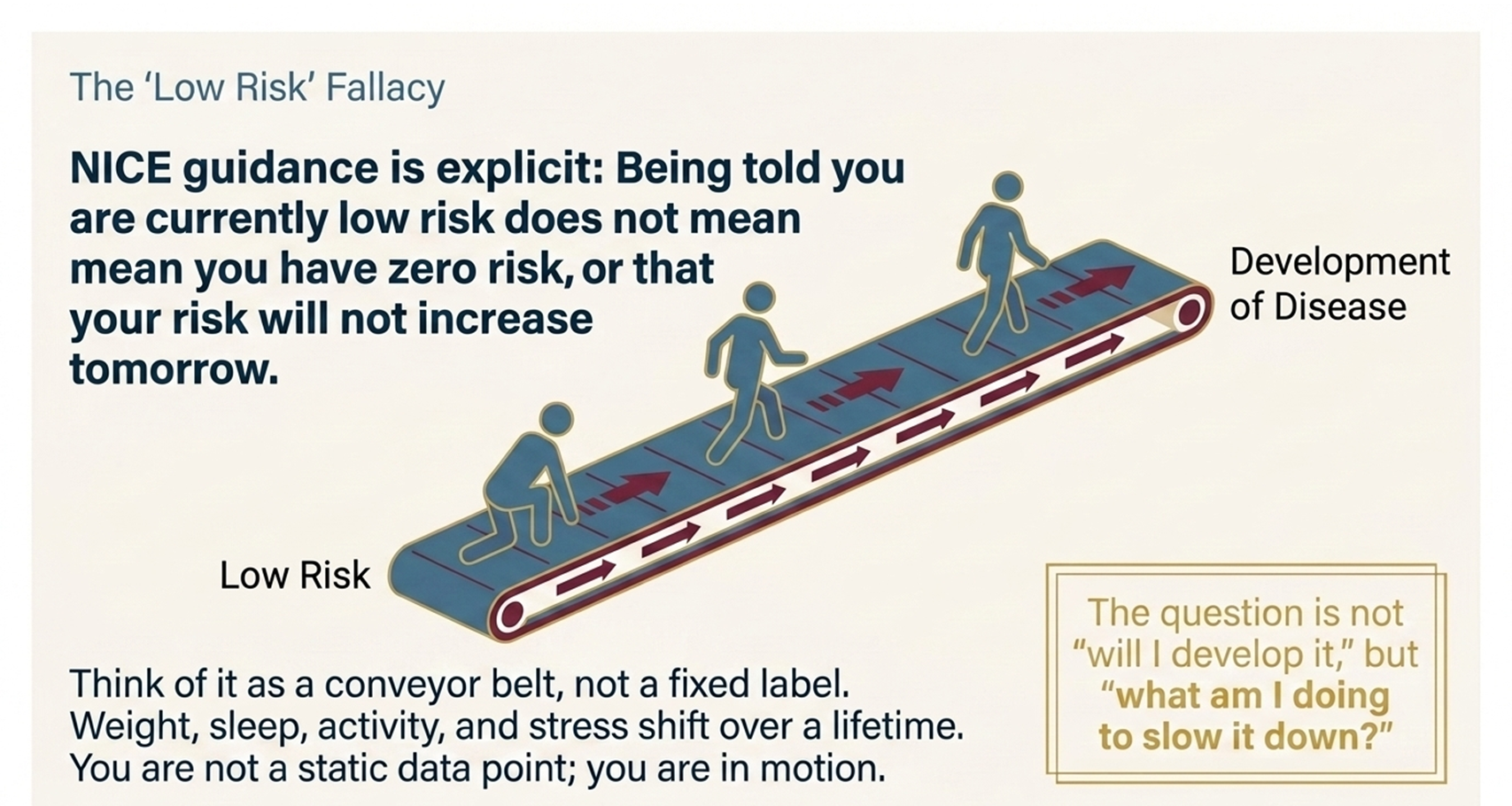
- NICE guidance is explicit on this point. Being told you are currently low risk does not mean you have no risk, or that your risk will not increase in the future.[1]
- Think of it as a conveyor belt, not a fixed label. Everyone living in today’s food environment, today’s work patterns, and today’s levels of chronic stress is moving along it, some faster than others.
- Having none of the risk factors above today does not mean you are exempt tomorrow. Weight, sleep, activity, and stress all shift over a lifetime.
- The more useful mindset is not “will I develop type 2 diabetes” but “when, and what am I doing to slow that down.”
When It Might Not Be Type 2: The LADA Possibility
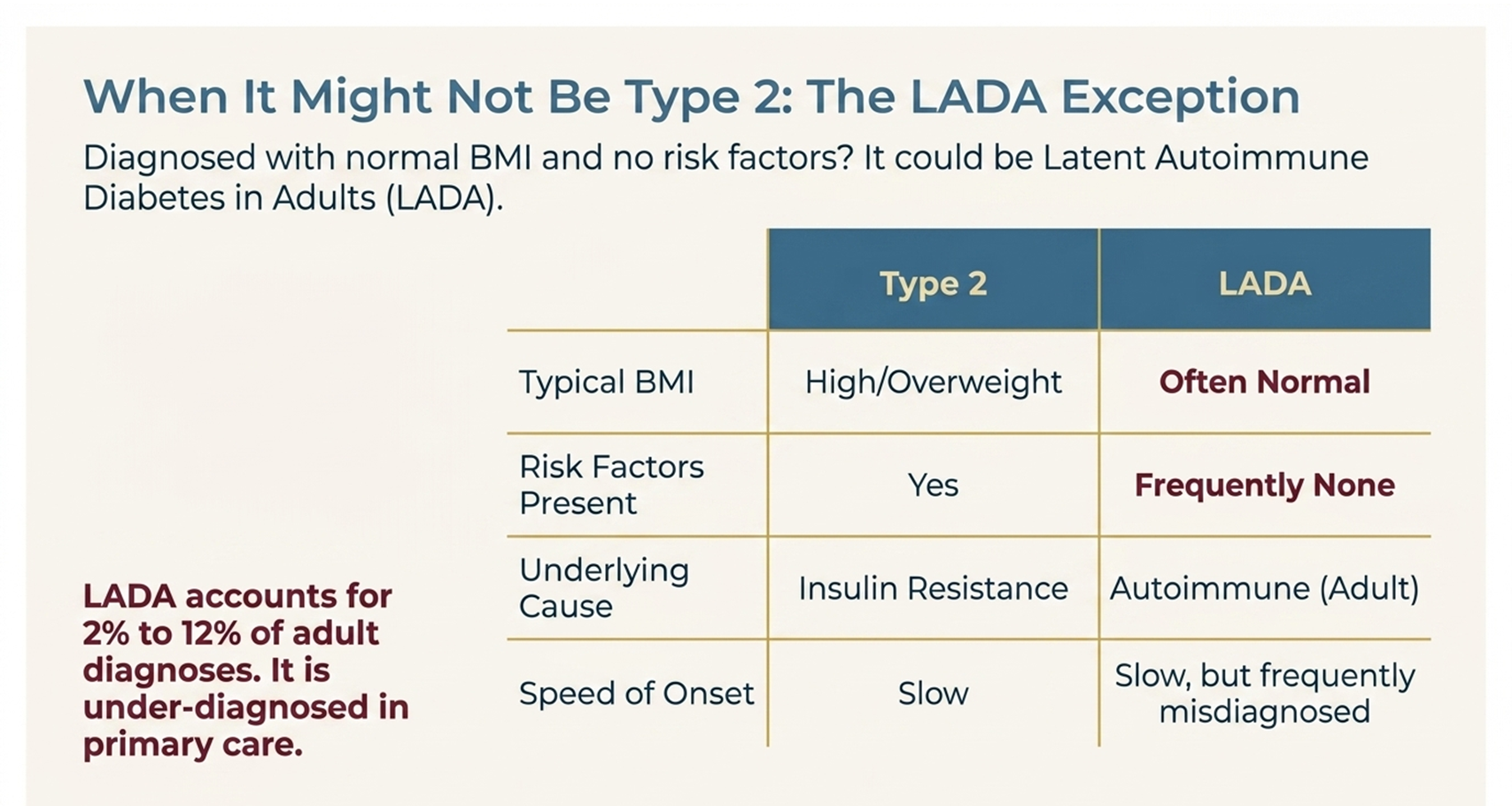
- Occasionally, someone is diagnosed with type 2 diabetes despite a normal BMI and none of the usual risk factors above.
- This is worth flagging clearly: it may not be type 2 diabetes at all. It could be LADA, latent autoimmune diabetes in adults, a slower-moving autoimmune condition that is frequently mistaken for type 2 at diagnosis.
- LADA accounts for an estimated 2 to 12 in every 100 adults diagnosed with diabetes, and is diagnosed far less often in primary care than it should be.[2]
- If your diagnosis does not fit the risk-factor picture above, it is reasonable to raise this question with your doctor. We will be covering LADA in full detail in a dedicated post soon.
Find Out How Far Along You Are
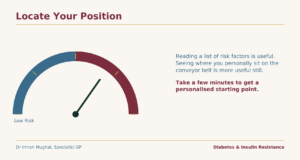
- Reading a list of risk factors is useful. Seeing where you personally sit on that list is more useful.
- Our Diabetes Risk Checker takes the factors above and gives you a general indication of where you stand in a few minutes.
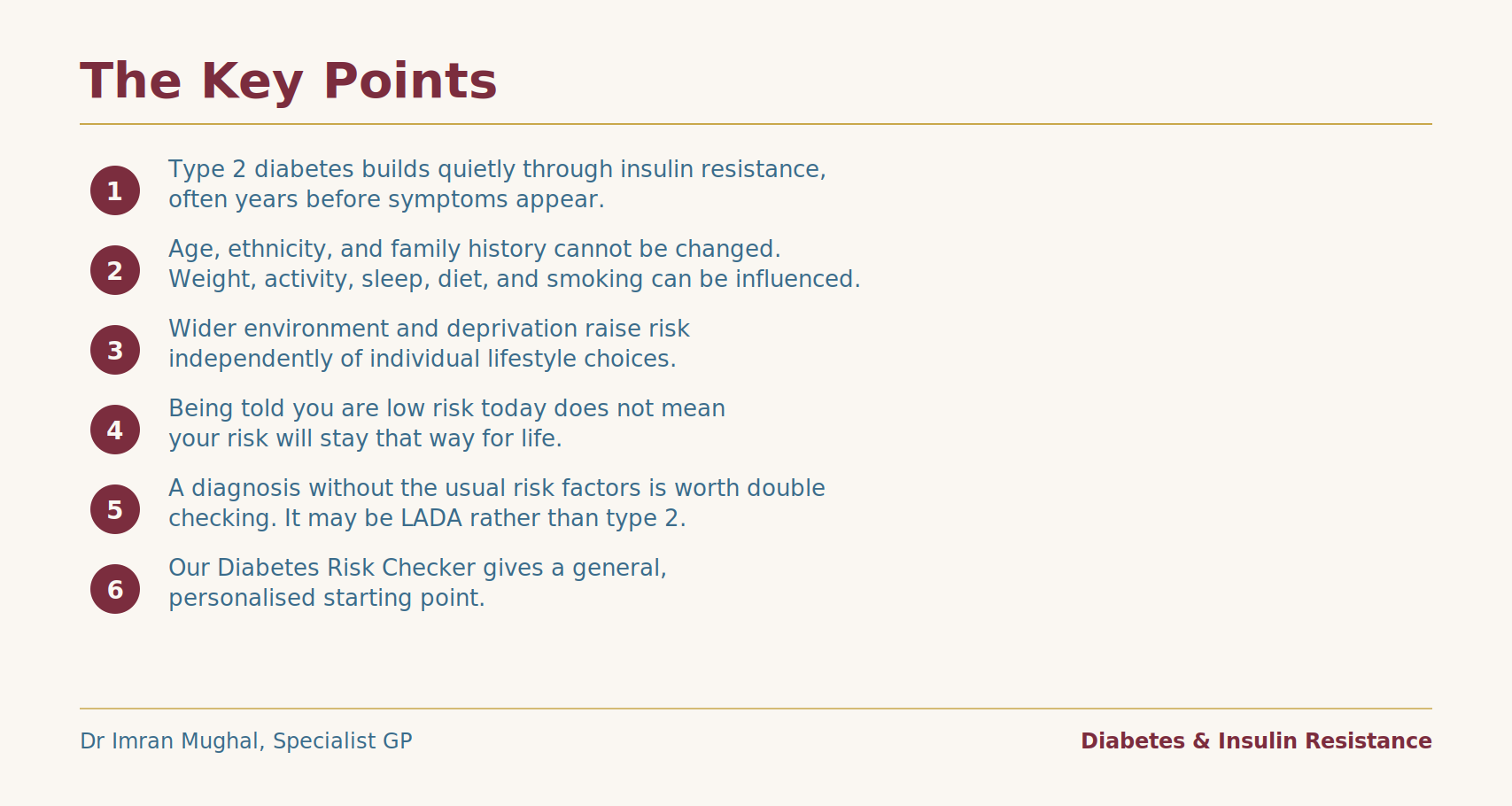
The Key Points
- Type 2 diabetes builds quietly through insulin resistance, often years before symptoms appear.
- Some risk factors, including age, ethnicity, and family history, cannot be changed. Others, including weight, activity, sleep, diet, and smoking, can be influenced.
- Wider environment and deprivation raise risk independently of individual lifestyle choices.
- Being told you are low risk today does not mean your risk will stay that way for life.
- A diagnosis of type 2 diabetes without the usual risk factors present is worth double-checking, since it may be LADA rather than type 2.
- Our Diabetes Risk Checker gives a general, personalised starting point.
Why see the same doctor every time?
- One GP, start to finish. Dr Imran Mughal follows your risk profile and results over time, not a different clinician reviewing you from scratch each visit.
- Your results in context. HbA1c and risk factors are reviewed against your own history, not read in isolation.
- A plan that adapts. Prevention advice changes as your risk changes, not a one size leaflet.
What This Means For You
- If you recognise several of the factors above, it is worth raising at your next GP visit rather than waiting for symptoms.
- If you recognise none of them but were still diagnosed with type 2 diabetes, ask whether LADA has been considered.
- Small, sustained changes to activity, sleep, and diet genuinely shift your position on the conveyor belt, even without weight loss as the main goal.
- At IM Clinic, we take the time to look at your full risk picture, not just a single test result. Read more about your metabolic journey from normal blood sugar to diabetes, or the symptoms of type 2 diabetes people miss. If you already have a diagnosis, see whether type 2 diabetes can be reversed.
Author: Dr Imran Mughal, Private Specialist GP
Website: www.imclinic.co.uk
Book a consultation: https://notes.thanksdoc.co.uk/book/clinic/im-clinic
References
NICE. Type 2 diabetes: prevention in people at high risk. NICE guideline PH38. 2012, updated 2017.
Buzzetti R, Tuomi T, Mauricio D, Pietropaolo M, Zhou Z, Pozzilli P, Leslie RD. Management of Latent Autoimmune Diabetes in Adults: A Consensus Statement From an International Expert Panel. Diabetes. 2020;69(10):2037-2047.
Diabetes UK. Type 2 diabetes risk factors.

We would love to hear your thoughts. A few things to keep in mind before you post: